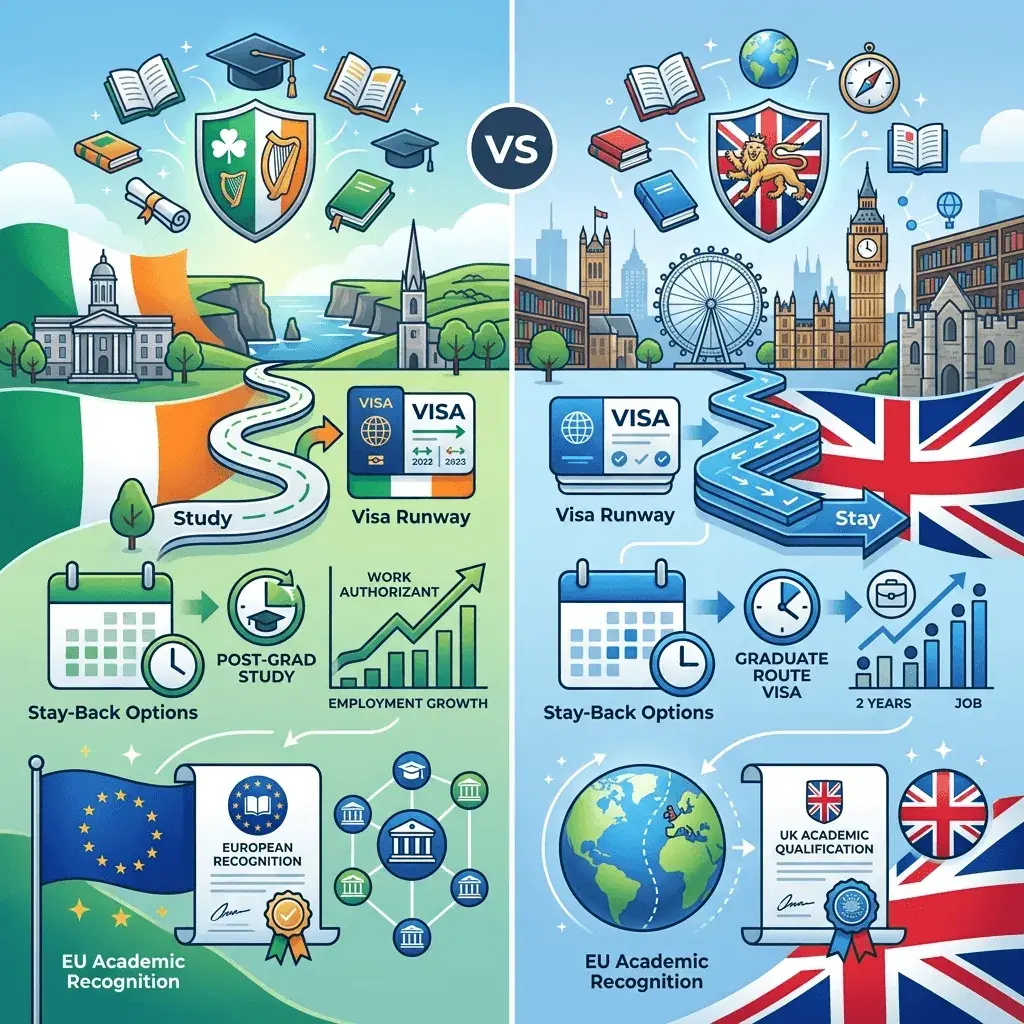
- EU Academic Recognition — An Irish NFQ Level 9 degree has automatic, treaty-backed academic recognition across all 27 EU member states via the Bologna Process and EQF, which UK degrees lost post-Brexit.
- Post-Study Work Runway — Ireland's Stamp 1G post-study pathway provides a stable 24-month post-study work window for master's graduates, compared to the UK Graduate Route which is shrinking to 18 months starting January 1, 2027.
- No Automatic Work Mobility — While Irish degrees are academically recognized EU-wide, they do not grant automatic work rights in other EU countries. Ireland does not participate in the EU Blue Card scheme, so graduates must apply for standard work visas to work elsewhere in Europe.
On 31 January 2020, every British university lost something it had held for nearly five decades without ever having to think about it: automatic, treaty-level academic citizenship inside the European Union. The UK's withdrawal from the EU did not just end freedom of movement for British citizens — it quietly pulled UK qualifications out of the EU-coordinated recognition architecture that still binds together the other 27 university systems on the continent.
Ireland did not move. It is still in the EU, still in the Bologna Process, and still the only member state where English is the dominant language of instruction and daily life. For an Indian student deciding between a master's in Manchester and a master's in Dublin, that single geopolitical fact has become one of the most underrated variables in the entire decision — more underrated, in many cases, than tuition fees or league table rankings. This guide breaks down exactly what an Irish NFQ Level 9 degree buys you in 2026 that a UK degree no longer can, using only verified, currently-in-force rules from Ireland's Department of Justice, the UK Home Office, and the European Commission.
What does "post-Brexit passport" actually mean for a degree?
It means that an Irish degree carries EU-wide academic recognition under the Bologna Process and the Lisbon Recognition Convention, while a UK degree — since Brexit — no longer sits inside that EU-coordinated recognition framework in the same automatic way. Ireland was one of the original 29 signatories of the 1999 Bologna Declaration, and its National Framework of Qualifications (NFQ) was formally verified as compatible with the Qualifications Framework of the European Higher Education Area in 2006. Ireland also ratified the Lisbon Recognition Convention in 2004, which exists specifically to let qualifications earned in one signatory country be fairly recognised in every other one. The Quality and Qualifications Ireland (QQI) body that issues NFQ comparability statements is itself a member of ENIC-NARIC, the EU-wide recognition network that employers and universities across the continent actually query when assessing a foreign qualification.
This is purely about how easily your degree itself is understood and trusted by a university, employer, or professional body in another EU country — it is a separate question from whether you are legally allowed to work in that other country, which we cover later in this guide.
NFQ Level 9 vs a UK master's: are they the same thing?
Yes, broadly — an NFQ Level 9 master's degree corresponds to the Bologna "second cycle," the same tier as a UK master's, but it sits inside a 10-level Irish framework that is explicitly cross-referenced to the European Qualifications Framework (EQF), giving it a documented equivalence path that a UK degree now has to establish bilaterally, university by university. Under the Irish NFQ, an honours bachelor's degree sits at Level 8 (Bologna first cycle), a master's degree or postgraduate diploma sits at Level 9 (Bologna second cycle), and a doctorate sits at Level 10 (Bologna third cycle).
| NFQ Level | Typical Award | Bologna Cycle | Stamp 1G Stay-Back |
|---|---|---|---|
| Level 7 | Ordinary Bachelor's Degree | First cycle (partial) | Not eligible (post-2017 enrolments) |
| Level 8 | Honours Bachelor's Degree / Higher Diploma | First cycle | 12 months |
| Level 9 | Master's Degree / Postgraduate Diploma | Second cycle | 24 months |
| Level 10 | Doctoral Degree / Higher Doctorate | Third cycle | 24 months |
If you want to verify exactly how a specific Irish award maps to your home qualification or a target country's framework, QQI's National Framework of Qualifications page and the ENIC-NARIC Ireland country profile are the two primary-source references to cite, not a consultancy blog.
How long can I stay and work in Ireland after a master's degree in 2026?
Up to 24 months, full-time, with no employer sponsorship and no salary threshold, under the Stamp 1G permission issued through the Third Level Graduate Programme (TLGP). According to Ireland's Immigration Service Delivery, graduates with an NFQ Level 9 award are granted permission for 12 months initially, which is then renewed for a further 12 months provided the graduate can show they are actively seeking graduate-level employment — attending interviews, registering with graduate recruiters, and so on. Level 8 honours bachelor's graduates get a single, non-renewable 12-month stamp.
You must apply within six months of receiving your final results, while your existing Stamp 2 student permission is still valid, and you must be physically present in Ireland to apply. The IRP renewal fee is €300. Dublin-based graduates apply online through the Immigration Service Delivery (ISD) portal; graduates outside Dublin register in person at their local Garda National Immigration Bureau office. Time spent on Stamp 1G counts toward Ireland's overall 7-year (Level 8) or 8-year (Level 9+) cap on non-EEA student-related permissions.
Crucially, the Stamp 1G allows you to work full time in any role, for any employer, in any sector, without needing a separate employment permit during that period — it is designed purely to give you a runway to find a job that can later sponsor you onto a long-term route such as the Critical Skills Employment Permit.
How long is the UK Graduate Route visa in 2026 and 2027?
If you apply on or before 31 December 2026, you still get the current 2-year permission (3 years for PhD holders). From 1 January 2027, the UK Graduate Route shrinks to 18 months for bachelor's and master's graduates — a change confirmed in the UK's May 2025 Immigration White Paper and formalised in a subsequent Statement of Changes to the Immigration Rules. According to the UK Council for International Student Affairs (UKCISA), this reduction applies only to applications made on or after 1 January 2027 — the date of application, not the date your course ends — and doctoral graduates remain unaffected at 3 years.
The House of Commons Library confirms the wider direction of UK immigration policy in 2026: tighter settlement rules, a higher English-language bar for indefinite leave to remain from March 2027, and a new international student levy of £925 per student per year of study starting in August 2028. None of this means the UK has shut its doors — but it does mean the post-study runway non-EU students are given to convert a UK degree into a long-term career is now visibly shrinking, year over year, in a way Ireland's Stamp 1G has not.
Side-by-side: Stamp 1G vs the UK Graduate Route in 2026
| Feature | Ireland — Stamp 1G (TLGP) | UK — Graduate Route |
|---|---|---|
| Duration (Master's/Level 9) | 24 months | 24 months if applied by 31 Dec 2026; 18 months from 1 Jan 2027 |
| Duration (PhD/Level 10) | 24 months | 36 months (unchanged) |
| Duration (Bachelor's/Level 8) | 12 months | 24 months if applied by 31 Dec 2026; 18 months from 1 Jan 2027 |
| Sponsorship needed | No | No |
| Salary threshold | None | None |
| Registration fee | €300 (IRP card) | £937 application fee + £2,070 Immigration Health Surcharge (from 8 April 2026) |
| Bridge to long-term permit | Critical Skills Employment Permit / General Employment Permit | Skilled Worker visa |
Sources: Trinity College Dublin Global Officer guidance, the UK government's official GOV.UK Graduate visa guidance, and DavidsonMorris immigration law briefing.
Does an EU Blue Card let an Irish graduate move freely around the EU?
No — and this is the single most misunderstood point in this entire debate. Ireland and Denmark are the only two EU member states that do not participate in the EU Blue Card scheme, so an Irish-based non-EU graduate cannot be issued an EU Blue Card by Ireland, and the Blue Card's simplified 12-month intra-EU mobility rule does not apply to them. According to the European Commission's official EU Immigration Portal, the EU Blue Card Directive applies in 25 of the 27 EU member states, with Ireland and Denmark excluded. So while a Blue Card holder in Germany can move to France for highly skilled employment after 12 months without repeating a full labour market test, an Irish-based graduate has no equivalent fast-track — they need to independently secure a job offer in the target country and apply for that country's own national work permit or Blue Card from scratch.
"Study in Ireland, work anywhere in the EU" is a marketing shorthand, not a legal fact. What genuinely travels across the EU without friction is the academic recognition of your NFQ Level 9 degree under the Bologna Process. What does not travel automatically is your right to work in any other specific EU country — that is still governed entirely by that country's own national immigration law, and Ireland's non-participation in the EU Blue Card scheme means there is no Ireland-specific shortcut into it.
The honest, accurate framing is this: an Irish degree is understood and trusted the same way everywhere in the EHEA the moment a German, Dutch, or Spanish employer looks at your transcript — because the NFQ-to-EQF referencing and the Lisbon Recognition Convention exist precisely to make that comparison painless. A UK degree, since Brexit, increasingly requires that same employer to make a bespoke, case-by-case judgement call, because the UK sits outside those EU-run frameworks now. That is the real value of the "post-Brexit passport" — recognition, not automatic work rights.
What is Ireland's Critical Skills Employment Permit, and how does it compare to the UK's Skilled Worker visa?
Ireland's Critical Skills Employment Permit (CSEP) requires a minimum salary of €40,904 a year (from 1 March 2026) for roles on the official Critical Skills Occupation List, or €68,911 for roles outside that list. The UK's Skilled Worker visa requires a minimum of £41,700 a year (roughly €48,000) or the occupation's published "going rate," whichever is higher, since 22 July 2025. Both routes are how a graduate transitions from a temporary post-study permission into a long-term, sponsored work visa.
| Feature | Ireland — Critical Skills Employment Permit | UK — Skilled Worker Visa |
|---|---|---|
| Minimum salary (with relevant degree) | €40,904/year (from 1 Mar 2026) | £41,700/year or going rate (from 22 Jul 2025) |
| Recent-graduate discount | €36,848/year (graduated within 12 months) | New-entrant discount available for some under-26 / recent graduate cases |
| Employer sponsorship required | Yes | Yes — licensed sponsor + Certificate of Sponsorship |
| Skill level requirement | Degree-level role on Critical Skills list | RQF Level 6 (graduate-level) role |
| Path to long-term residency | Stamp 4 after qualifying period | Indefinite Leave to Remain (qualifying period proposed to rise from 5 to 10 years under 2026 reforms) |
Sources: Ireland's Department of Enterprise, Tourism and Employment and GOV.UK's Skilled Worker visa guidance.
Ireland's thresholds are rising too — the Critical Skills Employment Permit minimum is on a published roadmap to climb further through 2030, and the 50:50 rule (an employer cannot have more than 50% non-EEA staff for most permit types) can restrict which Irish employers can sponsor you. Neither country is "easy" at the sponsorship stage; the real difference is in how much breathing room the post-study window gives you to find that sponsoring employer in the first place.
Is an Irish master's degree cheaper than a UK master's degree?
Generally yes. Average Irish master's tuition for international students runs roughly €9,000 to €35,000 per year, compared with roughly £10,000 to £38,000 (about €11,600 to €44,000) per year in the UK, and most Irish master's programmes are completed in a single year rather than the 18-24 months common for some UK postgraduate courses. According to Mastersportal's 2026 cost breakdown, postgraduate tuition for non-EU students at Irish public universities typically falls between €4,000 and €35,000 a year, with medicine and MBA programmes going higher.
How are students actually weighing this decision?
Which factors should actually drive your decision?
Treat this as a weighted decision across five factors: post-study work duration, total cost, degree recognition pathway, salary threshold for long-term sponsorship, and whether your target career sector has stronger demand in Ireland's tech/pharma cluster or the UK's broader economy. No single factor should be decisive on its own.
-
If your priority is maximum job-search runway: Ireland's 24-month Stamp 1G for a master's degree currently beats the UK's post-2027 18-month Graduate Route by a full six months — a meaningful amount of time when graduate recruitment cycles in Europe often run 6-9 months from application to offer.
-
If your priority is lowest total cost: Ireland's one-year master's programmes combined with generally lower tuition typically produce a lower all-in cost than an equivalent UK qualification, though you should always model this against the specific university and course, not the country average.
-
If your long-term goal is working in continental Europe (Germany, Netherlands, France): Your NFQ Level 9 degree will be read cleanly by EU employers thanks to Bologna/EQF referencing, but you will still need to independently qualify for that country's own work permit or EU Blue Card — Ireland's Blue Card opt-out means there is no Dublin-based shortcut.
-
If your target sector is finance, law, or established multinational HQs: the UK's deeper and more mature graduate-scheme ecosystem in London may still outweigh Ireland's tighter post-study visa window, particularly in sectors where the UK remains the larger employment market.
How does this affect your flight planning to Ireland?
Once you have chosen Ireland, book your one-way ticket to Dublin (DUB), Cork (ORK), or Shannon (SNN) using a verified student fare and confirm your IRP appointment slot before you travel, since Burgh Quay registration windows fill up fast during the September intake. If you are flying via the Middle East or a European hub, compare student fares directly through our MyFlightOffers flight search, and check our dedicated guide on student airfare discounts for how to validate ISIC eligibility and baggage allowances before you book — a 23kg single-bag European carrier fare can quietly cost more than a 40kg Gulf-carrier fare once you account for the extra baggage fee a Master's move usually requires.
Conclusion
The phrase "post-Brexit passport" is a useful shorthand, but the underlying mechanism is precise and verifiable: Ireland stayed inside the EU's coordinated academic recognition architecture — the Bologna Process, the Lisbon Recognition Convention, and the EQF referencing that QQI maintains — while the UK stepped outside it. That makes an NFQ Level 9 degree easier for an employer or university anywhere in the European Higher Education Area to evaluate at face value, without a UK-style case-by-case judgement call.
On the immigration side, Ireland's Stamp 1G currently offers a longer, simpler post-study runway for master's graduates than the UK's Graduate Route will offer from January 2027, and it does so with no employer sponsorship and no salary threshold. What it does not offer — and what no honest guide should claim it offers — is a free pass to work anywhere in the EU, because Ireland deliberately sits outside the EU Blue Card scheme.
For an Indian student weighing Dublin against Manchester, Cork against Birmingham, or Galway against Glasgow, the decision should rest on the actual, current rules covered in this guide — not on a slogan. Read the official sources, model your own numbers against your specific course and target sector, and treat both countries' rules as moving targets that are revised on a near-annual basis.
Planning your move to Ireland?
Compare student flights to Dublin, Cork, and Shannon, and explore our full Ireland series for visas, housing, banking, and city-by-city living costs.
- Ireland Student City Guide: Dublin, Galway, Limerick, Athlone & Cork — a city-by-city look at campuses, neighbourhoods and student life across the country.
- Study in Ireland 2026: Complete Guide for International Students — the foundational guide to choosing a course, costs and the Stamp 1G route.
- Ireland Tech Jobs 2026: The AI Jobs Barometer CV Guide — how PwC's 2026 AI Jobs Barometer is reshaping entry-level tech hiring, and how to rewrite your CV/interview approach.
Frequently Asked Questions
Is an Irish degree recognised across the EU the same way as a UK degree used to be?
Academically, yes. Ireland's NFQ Level 9 qualifications are referenced to the Bologna Process and the Qualifications Framework of the European Higher Education Area, and Ireland ratified the Lisbon Recognition Convention in 2004, so the degree itself is comparable and recognisable across all EHEA countries. The UK left these EU-coordinated recognition structures after Brexit, so a UK degree no longer carries the same automatic, treaty-backed comparability inside the EU that it did before 2020. Work authorisation in each EU country is a separate legal matter from academic recognition of the degree.
Can an EU Blue Card help an Irish graduate work elsewhere in the EU?
No. Ireland and Denmark are the only two EU member states that do not participate in the EU Blue Card scheme. A non-EU graduate of an Irish university cannot be issued an EU Blue Card by Ireland, and Blue Card mobility rules (which let holders move to a second member state after 12 months) do not apply to Irish-based workers. To work in another EU country, an Irish graduate generally needs to secure a job offer there and apply for that country's own national work permit or Blue Card directly.
All visa durations, salary thresholds, qualification frameworks, and immigration rules described in this article are based on publicly available information from Ireland's Immigration Service Delivery, the Department of Enterprise, Tourism and Employment, the UK Home Office and GOV.UK, the European Commission, and Quality and Qualifications Ireland (QQI) as of June 2026. Immigration rules, salary thresholds, and qualification recognition policies are revised frequently and can change without notice. Always verify current rules directly through the official government sources linked in this article, or consult a qualified immigration adviser, before making study or relocation decisions. MyFlightOffers is not affiliated with the Irish or UK governments, the European Commission, or any university mentioned in this article. This article does not constitute immigration, legal, or financial advice.