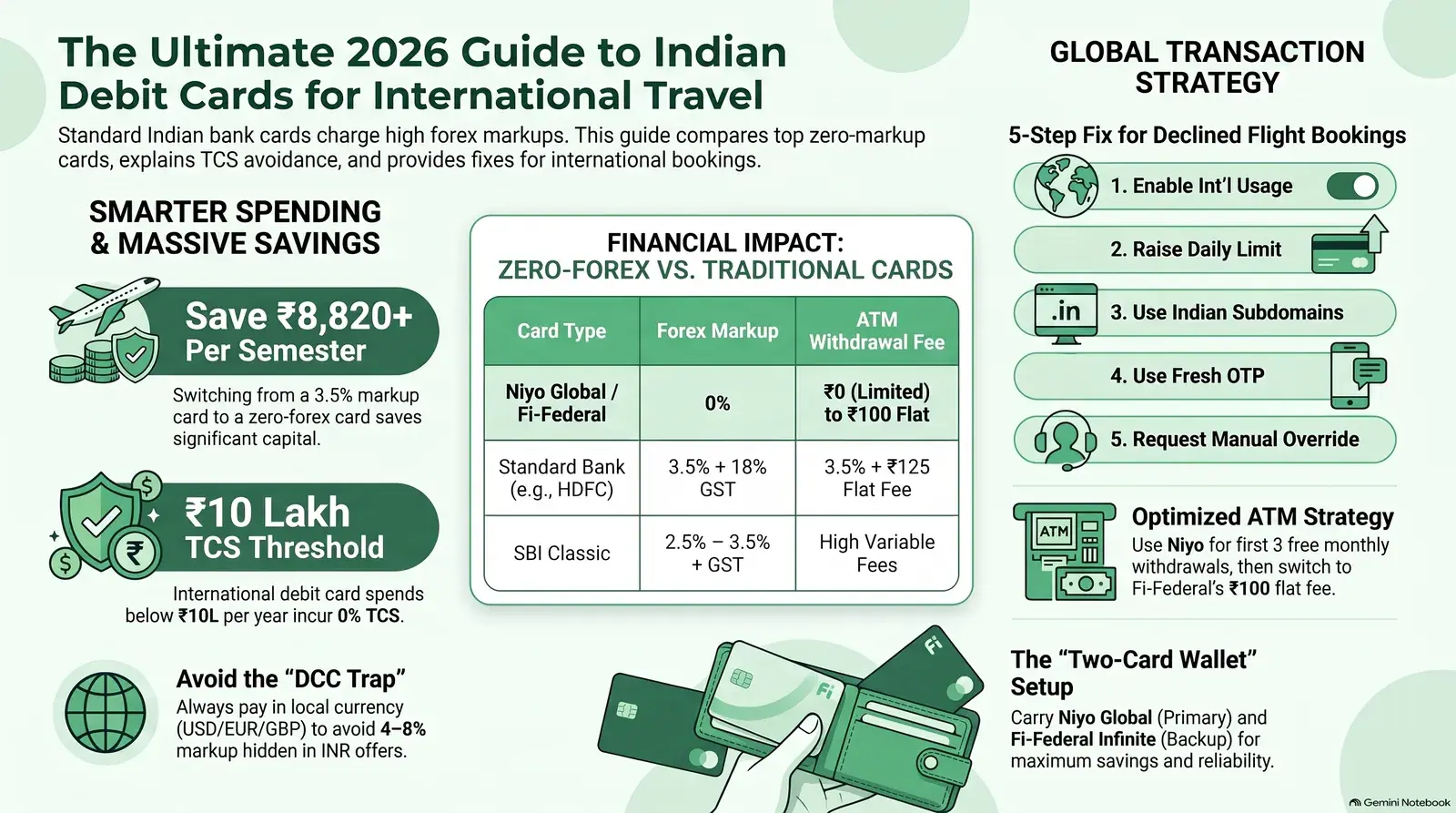
- Zero-forex debit cards exist: Niyo Global (SBM), Fi-Federal (Infinite/Salary/Prime plan), and RBL Signature+ all carry 0% forex markup — saving you ₹5,250 on every ₹1.5 lakh spent abroad vs. a standard 3.5% bank debit card.
- Declined flights are fixable: Most declines happen because international usage is disabled in your app, or your daily limit is below the fare. Enable it in 60 seconds, or call the bank to temporarily raise the limit before buying.
- TCS threshold is ₹10 lakh for 2026: Debit card international spends below ₹10 lakh per financial year are TCS-free. Above ₹10 lakh, a 2% TCS applies (for medical/travel), refundable via ITR filing.
Niyo Global (SBM Bank) — 0% markup, free account, 3 free ATM withdrawals abroad
Fi-Federal Bank (Infinite/Salary plan) — 0% markup + ₹100 flat ATM fee
3.5% + 18% GST on every international purchase or ATM withdrawal
₹10 lakh per financial year (Finance Act 2026, effective 1 April 2026)
In this guide
- Zero-forex debit card comparison (2026)
- What standard bank debit cards actually cost abroad
- Why your debit card is declined on flight websites — and how to fix it
- The DCC trap: always pay in local currency
- Daily limits and how to raise them for big ticket purchases
- ATM strategy abroad: cheapest cash withdrawal combinations
- TCS on debit card international spends: 2026 rules explained
- Forex markup savings calculator
- Verdict: best debit setup for students and travellers
- Frequently asked questions
Which Indian debit cards have zero forex markup for international use in 2026?
Three fintech-backed debit cards — Niyo Global (SBM Bank), Fi-Federal Bank, and RBL Signature+ — carry 0% forex markup on all international card-present and card-not-present transactions as of August 2026, while traditional bank debit cards from HDFC, ICICI, and SBI charge 3.5% on every overseas swipe. The table below compares every major option side by side with verified fee data from each issuer's official schedule.
| Debit Card | Forex Markup | International ATM Fee | Joining / Annual Fee | Daily ATM Limit | Key Con |
|---|---|---|---|---|---|
| Niyo Global (SBM Bank) BEST OVERALL | 0% | 3 free, then ₹423 + 18% GST (~₹499) | ₹0 joining, ₹0 annual | Up to ₹2 lakh | Minimum balance requirement on SBM savings account |
| Fi-Federal Bank (Infinite/Salary/Prime plan) | 0% | ₹100 flat per withdrawal | ₹0 (plan-based) | Varies by country ATM operator | Zero markup only on Infinite/Salary/Prime plans; Standard plan charges 3.5% |
| Fi-Federal Bank (Plus/Salary Basic plan) | 0% up to ₹30,000/month, then 3.5% | ₹100 flat | ₹0 | Varies | Cap of ₹30,000/month limits use for large purchases |
| RBL Bank Signature+ | 0% | ₹0 (exact policy — verify with RBL) | Premium tier applies | ₹2 lakh ATM, ₹4 lakh purchases/day | Premium account required; not available to all segments |
| HDFC Millennia Debit | 3.5% + 18% GST | 3.5% conversion + flat ₹125 fee | ₹500/year | Up to ₹1–5 lakh depending on account type | Expensive for frequent international use |
| ICICI Regular Debit (Coral/Rubyx) | 3.5% + GST (hiking from June 2026) | 3.5% + flat fee | ₹500–₹750/year | Varies by tier | ICICI hiking international fees as of June 2026 |
| SBI Classic/Platinum Debit | 2.5–3.5% + GST | 3.5% + ₹100 flat | ₹125–₹300/year | ₹1 lakh (Classic), ₹2 lakh (Platinum) | Higher OTP failure rates on foreign 3DS environments |
Sources: Official fee schedules from SBM Bank Niyo Global page, Fi Money fees page, RBL Bank service charges, and HDFC Millennia debit fees, verified August 2026.
What do standard bank debit cards actually cost abroad?
Using a standard HDFC, SBI, or ICICI debit card abroad in 2026 costs 3.5% forex markup plus 18% GST on that markup on every transaction — meaning the effective surcharge on a ₹50,000 international flight purchase is approximately ₹2,044. On a semester's worth of spending (₹1.5 lakh), the invisible cost rises to ₹6,135.
Here is the true cost breakdown on ₹1,50,000 of international spend, comparing a zero-forex card against a standard 3.5% card:
| Cost Component | Zero-Forex Card (Niyo/Fi) | Standard Bank Debit (3.5%) |
|---|---|---|
| Forex markup fee | ₹0 | ₹5,250 (3.5% × ₹1,50,000) |
| GST on markup (18%) | ₹0 | ₹945 |
| ATM fees (5 withdrawals, ₹10,000 each) | ₹500 (Fi: 5 × ₹100) | ₹3,125 (3.5% × ₹50,000 + flat ₹125 × 5) |
| Total extra cost vs. mid-market rate | ₹500 | ₹9,320 |
The ₹8,820 saving on a single semester's spend is the single most compelling reason to switch before you travel — ahead of any rewards programme or cashback offer.
Why is my Indian debit card declined on foreign flight websites — and how to fix it?
The most common cause of an Indian debit card being declined on foreign airline websites (Emirates, Lufthansa, Air France, American Airlines) is that international card usage is disabled by default in the bank's app — re-enabling it takes under 60 seconds and resolves the majority of declines without any call to the bank.
There are five distinct causes, each with a different fix:
1. International usage disabled (most common)
Your debit card is almost certainly disabled for international card-not-present (CNP) transactions by default, per RBI's security guidelines. Navigate to your bank's mobile app, go to "Card Settings" or "Card Controls," and toggle "International Online Transactions" to ON. This change is instant and reversible. HDFC, ICICI, SBI, Axis, Kotak, and most major banks all implement this same control. Re-disable it when you return to reduce fraud risk.
2. Daily purchase limit below the fare
A standard HDFC Millennia debit card's default daily international purchase limit may be ₹50,000 — well below the cost of a long-haul flight. Log into net banking or the mobile app and temporarily increase the international daily purchase limit (HDFC allows up to ₹5 lakh per day via self-service). If the app does not allow self-serve increases, call the 24-hour helpline and request a 48-hour international limit enhancement. Do this the day before you plan to book.
3. 3DS version mismatch
Indian banks running 3D Secure 1.0 can fail authentication when a foreign airline's payment gateway sends a 3DS 2.0 challenge request — the two protocols are not fully backward compatible. If an OTP screen never appears and the transaction silently declines, this is likely the cause. The workaround: try booking through the Indian subdomain of the airline's website (e.g. in.emirates.com or the Indian version of the booking page) which routes through Indian payment gateways that handle 3DS 1.0 correctly. Alternatively, use Google Pay or Paytm to add your debit card as a funding source — the payment platform abstracts the 3DS layer.
4. RBI e-mandate and recurring payment blocks
RBI mandates that all recurring debits above ₹15,000 from Indian-issued cards require fresh additional factor authentication (AFA — typically an OTP) at the time of each charge. For one-time airline ticket purchases this is rarely the issue, but if you are booking a subscription-based airfare service or a hotel that pre-authorises and then charges, the bank may block the final charge if the initial hold was not set up as an RBI-compliant e-mandate. Contact the merchant to initiate a compliant e-mandate flow, or pay via a credit card that has better support for cross-border recurring flows.
5. Cross-border card-not-present validation (October 2026 deadline)
The Reserve Bank of India (RBI) has mandated that all Indian banks implement a validation mechanism for non-recurring cross-border CNP transactions by 1 October 2026. Until full implementation, some banks' older transaction routing may cause sporadic declines on foreign merchant sites. If you face persistent issues with a specific airline's website, call your bank and ask whether their cross-border CNP validation is live — if not, request manual override clearance for your transaction.
The DCC trap: always pay in local currency, never in rupees
Dynamic Currency Conversion (DCC) is a trap where a foreign ATM or airline website offers to charge your card in Indian Rupees — at a rate they set, which is typically 4% to 8% above the mid-market rate, even if you already have a zero-forex card. Always select "Pay in [local currency]" (EUR, GBP, USD, AED, etc.) and never "Pay in INR."
If you have a Niyo Global or Fi card (0% forex markup) and accept DCC at a foreign ATM or checkout, the DCC operator's rate — not Visa/Mastercard's mid-market rate — is applied. The DCC markup (typically 4–8%) completely negates the zero-forex benefit. Always decline DCC.
The DCC trap appears in two contexts:
At foreign ATMs: The ATM screen shows a box saying "Do you want to pay in INR? The exchange rate is ₹X.XX per EUR." The rate shown is always worse than the mid-market rate. Press "No" or "Decline DCC" and the ATM will charge you in local currency — your zero-forex card then converts at the Visa/Mastercard network rate, which is within 0.1–0.3% of the interbank rate.
On airline and hotel websites: Some booking engines (particularly legacy systems used by regional airlines) default to displaying fares in INR for Indian-issued cards and process the charge in INR via a DCC provider. Switch the currency selector to the airline's home currency (e.g. EUR for Ryanair, GBP for British Airways) before entering your card details. The page may refresh with the same fare in local currency — this is intentional and always produces a better rate.
Daily limits and how to raise them for a big-ticket flight purchase
Indian debit cards carry separate domestic and international daily limits for ATM withdrawals and point-of-sale/online purchases — and the international limits are often set far lower than domestic limits, sometimes as low as ₹25,000 per day for older accounts. Checking and increasing these limits before you book is the single most effective step to ensure a ₹1–2 lakh flight purchase goes through first time.
| Bank | Default International Purchase Limit | Maximum Allowed | How to Increase |
|---|---|---|---|
| HDFC Bank | ₹50,000–₹1 lakh/day | Up to ₹5 lakh/day | NetBanking → Cards → Set Debit Card Limits (self-service, instant) |
| ICICI Bank | ₹50,000/day | Up to ₹2 lakh/day | iMobile Pay → Cards → Usage Settings → International Transactions |
| SBI | ₹50,000/day (Classic) | ₹2 lakh (Platinum) | YONO app → Cards → Card Management → Limit Change |
| RBL Bank (Signature+) | ₹2 lakh ATM, ₹4 lakh purchases | ₹4 lakh purchases/day | RBL MoBank app → Card Controls (or customer care) |
| Niyo Global (SBM) | Up to ₹2 lakh/day | ₹2 lakh/day | Niyo app → Card controls (instant toggle) |
On-the-Ground Insight: "I tried booking my Dublin to Delhi return flight on Emirates.com using my father's HDFC Platinum debit card — the transaction failed three times. The fare was ₹1,10,000 but the card's international daily limit was ₹50,000. We called HDFC, they increased it to ₹2 lakh for 24 hours via net banking, and the booking went through immediately on the fourth attempt. The fare had not changed — we just needed a bigger pipe." — Priya R., TU Dublin, September 2025 Intake
ATM strategy abroad: the cheapest cash withdrawal combinations
The cheapest way to withdraw cash abroad with an Indian debit card in 2026 is the Niyo Global SBM card for the first three withdrawals per month (free), then switching to the Fi-Federal card at ₹100 flat per withdrawal — always declining the ATM's DCC offer to pay in the local currency.
Here is the per-withdrawal cost breakdown for common amounts:
| Card | Withdraw ₹10,000 abroad | Withdraw ₹30,000 abroad | Free withdrawals/month |
|---|---|---|---|
| Niyo Global (SBM) — within free limit | ₹0 | ₹0 | 3 |
| Niyo Global (SBM) — beyond free limit | ₹499 (₹423 + 18% GST) | ₹499 | 3 free, then ₹499/withdrawal |
| Fi-Federal (Infinite plan) | ₹100 flat | ₹100 flat | 0 (₹100 applies from first withdrawal) |
| HDFC Millennia (3.5% + flat) | ₹476 (3.5% × ₹10,000 + ₹125) | ₹1,175 (3.5% × ₹30,000 + ₹125) | 0 |
| SBI Classic (3.5%) | ₹450 (3.5% × ₹10,000 + ₹100) | ₹1,150 | 0 |
The optimal strategy for students studying abroad for a semester:
- Use the Niyo Global SBM card for your first three ATM visits each month — free.
- For further cash needs, switch to the Fi-Federal card at ₹100 flat — far cheaper than the ₹499 Niyo charges for withdrawals beyond the free allowance.
- For all card purchases (groceries, travel passes, online subscriptions), use whichever zero-forex card you have active — no cost difference between Niyo and Fi for purchase transactions.
- Always withdraw larger amounts less frequently — one ₹30,000 ATM withdrawal on Fi costs ₹100; three ₹10,000 withdrawals cost ₹300.
TCS on Indian debit card international spends: 2026 rules explained simply
From 1 April 2026 (Finance Act 2026), Tax Collected at Source (TCS) on debit card international transactions applies only when your total outward foreign remittances under the Liberalised Remittance Scheme (LRS) exceed ₹10 lakh in a financial year — below that threshold, 0% TCS. This replaced the previous ₹7 lakh threshold set by the Finance Act 2025.
The following rates apply from 1 April 2026 per the Finance Act 2026, verified against the Income Tax India official portal:
- Standalone international air tickets: 0% TCS (never applied, regardless of amount)
- Debit card foreign spend below ₹10 lakh/FY: 0% TCS
- Medical treatment / travel remittances above ₹10 lakh/FY: 2% TCS on the excess
- Overseas tour packages (budget/hotel/flight bundles): 2% TCS per remittance, no minimum threshold
- Other LRS remittances above ₹10 lakh/FY: 20% TCS on the excess
- International credit card spends while overseas: TCS classification postponed (no TCS currently)
The key practical point for most students and frequent travellers: debit card international spending below ₹10 lakh per year is completely TCS-free. Only those remitting significant sums (e.g. tuition fees plus living costs above ₹10 lakh from a single account) need to track the threshold. And even when TCS is collected, it is not a tax lost — it is a credit against your income tax liability, refundable via ITR filing if your net tax payable is lower than the TCS collected.
Your bank tracks cumulative LRS outflows from your account. Once the ₹10 lakh threshold is crossed in a financial year, the bank automatically deducts TCS on each subsequent remittance and deposits it with the government. You do not need to calculate it — but you should monitor your cumulative LRS usage if you have multiple sending accounts (the ₹10 lakh limit applies per PAN, not per account).
🧮 Forex markup savings calculator
🧮 Forex Markup Savings Calculator
Enter your typical monthly international spend and ATM usage to see how much you save switching from a standard bank debit card (3.5% markup) to a zero-forex card.
Verdict: the best debit card setup for students, parents, and occasional travellers in 2026
For most Indian students and travellers, the optimal 2026 debit card setup is a two-card wallet: the Niyo Global SBM card for the first three monthly ATM withdrawals (free), paired with a Fi-Federal Bank account on the Infinite or Salary plan for all subsequent ATM visits and as a backup card for purchases.
True International Cost = Forex Markup Fee + GST on Markup + ATM Withdrawal Fees + DCC Surcharge (if accepted)
How each profile should approach their debit card strategy:
Students going abroad for a full semester or year: Open a Niyo Global SBM account and Fi-Federal account at least 2 weeks before departure (cards take 3–7 business days to arrive). Carry both cards, keep them enabled for international transactions, and use them as primary cards — relegating your home bank debit card to emergencies only. Annual saving vs. a standard HDFC card on ₹50,000/month spend: approximately ₹6,000–₹8,000.
Parents sending children studying abroad: Your HDFC, ICICI, or SBI card is fine for domestic transactions — but open a Niyo or Fi account specifically for international use. The zero joining fee means there is no downside to having the card sit idle when not travelling.
Occasional international travellers (1–2 trips per year): The Niyo Global SBM card is sufficient — free account, zero markup, 3 free ATM withdrawals per trip. The con: if you are inactive for a long period the account may require reactivation, and the SBM minimum balance requirement should be checked against your account type.
High-spend remitters approaching the ₹10 lakh LRS threshold: Switch purchases to an international credit card for which TCS classification is currently postponed (credit card overseas spends are not counted as LRS until further RBI notice). This keeps your debit card LRS balance lower and defers or avoids TCS triggering.
Frequently asked questions
Which Indian debit card has zero forex markup for international use in 2026?
The top zero-forex Indian debit cards in 2026 are the Niyo Global (SBM Bank) debit card, the Fi-Federal Bank debit card (on Infinite/Salary/Prime plans), and the RBL Bank Signature+ debit card. All carry 0% forex markup on international purchases. Standard bank debit cards like HDFC Millennia charge 3.5% + GST, costing roughly ₹5,250 extra on every ₹1.5 lakh spent abroad.
Why is my Indian debit card declined on foreign flight websites?
The most common reasons are: (1) international transactions are disabled — enable them in your bank's mobile app; (2) a 3D Secure version mismatch between your bank (3DS 1.0) and the airline's payment gateway (3DS 2.0); (3) your daily purchase limit is lower than the fare — call your bank to request a temporary increase; (4) the RBI e-mandate framework blocks recurring charges above ₹15,000 without fresh OTP authentication. The fix is usually to enable international usage in the banking app, then try the transaction again through a VPN set to India to trigger the OTP flow correctly.
Does TCS apply to Indian debit card international spends in 2026?
TCS applies to debit card international spends only when aggregate LRS remittances in a financial year exceed ₹10 lakh. Below ₹10 lakh: 0% TCS. Above ₹10 lakh for medical or travel: 2% TCS (from 1 April 2026 per the Finance Act 2026). Standalone international air tickets are not subject to TCS regardless of amount. Overseas tour packages attract a flat 2% TCS per remittance with no minimum threshold from 1 April 2026.
How do I increase my debit card limit for a large flight booking?
Log into your bank's mobile or net banking app and navigate to the debit card settings — most banks (HDFC, ICICI, SBI, RBL) allow you to self-serve a temporary daily purchase limit increase without visiting a branch. HDFC allows limit increases up to ₹5 lakh per day online. If the app does not offer this, call the 24-hour banking helpline and request a temporary international limit enhancement for 24–48 hours before you purchase the ticket.
Ready to compare and book your international flight?
Now that you have the right debit card sorted, compare live fares on our calendar — including Dublin to Delhi, Dublin to Mumbai, and Dublin to Hyderabad routes used by most Indian students and expats in Ireland.
All fee figures, TCS rates, and card feature data are based on publicly available official sources as of August 2026. Card fees and RBI regulations can change — always verify current information directly with the relevant bank or the Reserve Bank of India before making financial decisions. MyFlightOffers is not affiliated with any bank, fintech, or card issuer mentioned. This article does not constitute financial or tax advice.
- Niyo Global vs Wise vs Bank Forex Cards 2026 — full comparison of every zero-markup travel card for Indian students abroad
- TCS on International Travel Spend India 2026 — complete LRS TCS guide for travellers, students, and remitters
- Card Tokenization for Flight Booking India 2026 — why tokenized cards work better on international airline sites
- Indian Card Declined on Foreign Airline Website: Fix 2026 — step-by-step troubleshooting for every major bank