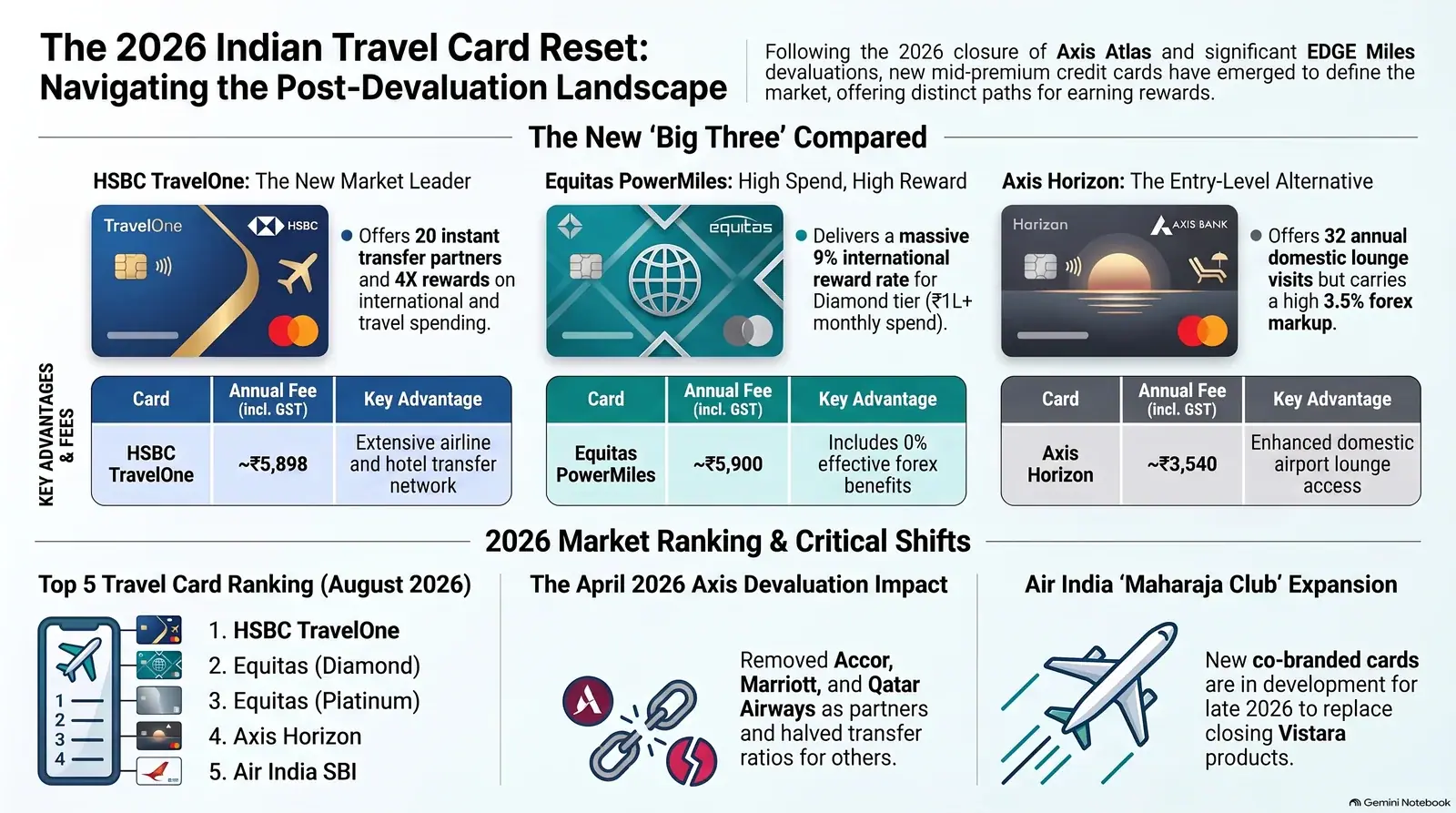
- Equitas PowerMiles: Up to 9% reward on international spend and 0% forex at the Diamond tier (₹1,00,000+ monthly for 3 consecutive months), but the Xchange transfer program is still rolling out from July 2026 — verify live partners before applying.
- Axis Horizon: The only Axis travel card open to new applicants after Atlas was closed; earns 5 EDGE Miles per ₹100 on travel at a ₹3,000 annual fee, but transfers 1:1 (not Atlas's 2:1) and carries a 3.5% forex markup.
- HSBC TravelOne: Stepped into the vacuum left by Atlas — 20 transfer partners (instant, no fee, mostly 1:1), 4X on international and OTA spends, ₹4,999 + GST annual fee, and the strongest flexible airmiles card available to new applicants in India right now.
₹5,000 + GST (waived at ₹4.8L annual spend)
₹3,000 + GST (lifetime free for Burgundy account holders)
₹4,999 + GST (≈₹5,898 including 18% GST)
Equitas Diamond tier — effectively 0%
In this guide
- Why banks are racing into travel cards in 2026
- Equitas PowerMiles: 3X international earn and the Privilege Program
- Axis Horizon: positioning below the discontinued Atlas
- HSBC TravelOne's rise and the mid-premium reshuffle
- Pipeline: Air India Maharaja Club co-brand and fintech entrants
- Updated top-5 travel cards for Indian flyers (August 2026)
- Equitas PowerMiles reward value calculator by tier
- Application strategy: which card gives best first-year value
- Devaluation-proofing: choosing cards with durable value
- Avoiding the DCC trap on international bookings
- Frequently asked questions
Why Are Indian Banks Launching Travel Credit Cards in 2026?
Indian banks are racing into the mid-premium travel card segment because the combined fallout from the Air India–Vistara merger and Axis Bank's April 2026 devaluation left a competitive vacuum that multiple product teams have moved to fill simultaneously. The ₹3,000–₹6,000 annual fee tier had been anchored by the Axis Atlas since 2022. With Atlas closed to new applicants and its partner list diminished by Axis's April 2026 revision — which removed Marriott Bonvoy, Accor, and Qatar Airways from the EDGE Miles programme — the field opened for the first time in years.
The Air India–Vistara integration has simultaneously created a new loyalty base hungry for co-branded earning products. Club Vistara IDFC FIRST Bank credit cards are closing on 30 September 2026, affecting hundreds of thousands of cardholders who need replacements. Equitas Small Finance Bank launched PowerMiles as a premium metal card with an innovative tiered-rewards structure. Axis reconfigured Horizon as its accessible entry point. HSBC TravelOne surged into the position Atlas vacated — all within an 18-month window. The result is the most competitive mid-premium launch cycle India's credit card market has seen since 2022.
Equitas PowerMiles: Is the 9% International Earn Rate Real?
Yes — the 9% headline figure on international spends is real, but only for cardholders who reach the Diamond Privilege tier, which requires spending ₹1,00,000 or more every month for three consecutive months within a calendar quarter. At the base Blue tier, the effective return on international spend is 4.5% (9 Reward Points per ₹100 at ₹0.50 per point redemption), which is already among the highest in the non-super-premium segment.
The Equitas PowerMiles Credit Card is issued as a metal card by Equitas Small Finance Bank. Its most distinctive feature is the five-tier Privilege Program, which improves reward rate, redemption value, and forex markup as monthly spending consistently rises. Key commercial terms verified as of August 2026:
| Privilege Tier | Monthly Spend Required (3 consecutive months) | Redemption Value per RP | Effective Intl Earn Rate | Forex Markup | Key Added Perks |
|---|---|---|---|---|---|
| Blue | Below ₹20,000 | ₹0.50 | 4.5% | 2% | Base tier |
| Silver | ₹20,001+ | ₹0.50 | 4.5% | 2% | 500 Bonus Reward Points |
| Gold | ₹40,001+ | ₹0.50 | 4.5% | 2% | ₹250 movie voucher + ₹500 Amazon voucher |
| Platinum | ₹60,001+ | ₹0.75 | 6.75% | 2% | 2 movie vouchers + 2 Amazon vouchers |
| Diamond | ₹1,00,001+ | ₹1.00 | 9% | 0% effective | 3 vouchers each, golf access (max 20/quarter), ₹3,000 flight voucher, ₹3,500 hotel voucher |
Source: Card Maven review, July 2026; official Equitas Bank card page. Flight and hotel vouchers are annual benefits, claimable once per financial year.
Earn rates: domestic vs international
Equitas PowerMiles earns 3 Reward Points per ₹100 on eligible domestic retail spends and 9 Reward Points per ₹100 on international retail transactions — a consistent 3X multiplier with no earning cap disclosed as of August 2026. Excluded categories include fuel, rent, wallet loads, cash withdrawals, EMI conversions, and certain merchant category codes. The card is available as a Visa metal card, requiring a minimum annual income of ₹18 lakh.
To understand the true value, note that redemption rate matters as much as earn rate. At standard Blue, Silver, and Gold tiers, the redemption rate is ₹0.50 per Reward Point — giving 1.5% domestic and 4.5% international effective returns. Platinum tier gives ₹0.75 per point (2.25% domestic, 6.75% international). Diamond doubles redemption to ₹1 per point (3% domestic, 9% international) and simultaneously eliminates the card's standard 2% forex markup, so the 9% gross reward faces no transaction-level levy on foreign currency purchases.
The Xchange transfer program
Equitas has announced the Xchange Program to allow Reward Points to transfer 1:1 to 10+ airline and hotel loyalty programs, including Air India Maharaja Club, Etihad Guest, and British Airways Executive Club, available from July 2026. As of August 2026, the rollout is still in progress. This is the card's biggest limitation relative to HSBC TravelOne: until the Xchange Program is fully live, Equitas points are best redeemed via the card's own travel portal at ₹0.50–₹1 per point, rather than at the potentially higher value available through airline mile redemptions.
Fees, eligibility, and welcome benefits
Joining and annual fee: ₹5,000 + GST each. Joining fee is waived on spending ₹1.2 lakh within the first 90 days of card issuance. Renewal fee is waived on spending ₹4.8 lakh in the preceding membership year. Add-on card fee: ₹3,500 + GST. Lounge access: 2 domestic airport lounge visits and 1 international airport lounge visit per calendar quarter (8 domestic + 4 international annually), plus a complimentary Priority Pass worldwide membership. Welcome benefits include a Club Marriott membership (up to 25% savings on dining, hotel stays, and spa at participating properties) and an EazyDiner Prime membership (up to 50% dining savings, complimentary beverages, and 2,000 welcome EazyPoints) — both must be activated within 90 days of card issuance.
Pros: Up to 9% effective international reward rate at Diamond tier; 0% forex markup at Diamond; Club Marriott and EazyDiner Prime welcome memberships; fee waiver achievable at ₹4.8L annual spend; metal card with Priority Pass.
Cons: Diamond tier requires ₹1,00,000+ monthly for 3 consecutive months — most cardholders will not reach this. Xchange transfer program still rolling out as of August 2026. Higher income requirement (₹18L p.a.) than some competitors. Quarterly tier consistency requirement means one low-spend month can drop your tier.
On-the-Ground Insight: "I was sceptical of a travel card from a small finance bank, but after four months on Equitas PowerMiles I am consistently at Platinum tier. The ₹0.75/point redemption on flights through the portal works out better than most cashback cards at this fee tier. My only frustration is waiting for the Xchange Program to fully launch so I can transfer to KrisFlyer." — Rohan V., Senior Software Engineer, Dubai–Mumbai frequent flyer, 2026
How Does Axis Horizon Position Below the Discontinued Atlas Card?
Axis Horizon is now the only Axis Bank travel card open to new applicants in 2026 after Atlas was closed for fresh issuance — it earns the same 5 EDGE Miles per ₹100 on Travel Edge portal and airline spends but transfers at a 1:1 ratio rather than Atlas's 2:1 ratio, and carries a 3.5% forex markup on international transactions. The card originated as Citi PremierMiles and was rebranded to Axis Horizon following the Axis Bank acquisition of Citi India's retail business.
The Axis Bank Horizon Credit Card is positioned at ₹3,000 + GST annually, making it ₹2,000 cheaper than Atlas was. However, it lacks Atlas's milestone EDGE Miles awards (up to 10,000 points per year on reaching designated spends) and any spend-based annual fee waiver — you pay ₹3,000 + GST regardless of your annual spend volume, unless you hold an Axis Burgundy savings account, which grants the card lifetime free of charge.
| Feature | Axis Horizon | Axis Atlas (closed to new applicants) |
|---|---|---|
| Annual fee | ₹3,000 + GST | ₹5,000 + GST |
| Spend-based fee waiver | None | None |
| Travel earn rate | 5 EDGE Miles/₹100 (Travel Edge + airlines) | 5 EDGE Miles/₹100 (Travel Edge + hotels + flights) |
| Base earn rate | 2 EDGE Miles/₹100 | 2 EDGE Miles/₹100 |
| Transfer ratio (most partners) | 1 EDGE Mile = 1 partner point | 1 EDGE Mile = 2 partner points |
| Forex markup | 3.5% | 3.5% |
| Domestic lounge (Visa Signature) | 8 per quarter (32/year) | Tier-based, max 18/year |
| International lounge | 2 per quarter (8/year) | Tier-based, max 12/year |
| Welcome miles | 5,000 EDGE Miles on ₹1,000 spend within 30 days | 2,500 EDGE Miles on joining |
| Renewal miles | 1,500 EDGE Miles on anniversary | — |
| Milestone rewards | None | Up to 10,000 EDGE Miles at designated spend levels |
EDGE Miles transfer partners on Horizon after the April 2026 devaluation
Axis Bank removed Accor, Marriott Bonvoy, and Qatar Airways from the EDGE Miles partner list in April 2026 — affecting Atlas, Magnus, and Horizon — while adding British Airways Executive Club, Finnair Plus, and Vietnam Airlines Lotusmiles at a less favourable 2:1 transfer ratio. For Horizon (which already transferred at 1:1 rather than Atlas's 2:1), the practical impact is that these three new partners cost two EDGE Miles per one partner point, making them relatively expensive to use.
The remaining partners transfer 1:1 on Horizon and include Singapore Airlines KrisFlyer, Air France-KLM Flying Blue, Air India Maharaja Club, United MileagePlus, JAL Mileage Bank, Turkish Airlines Miles&Smiles, IHG One Rewards, Qantas Frequent Flyer, Radisson Rewards, SpiceJet SpiceClub, Etihad Guest, and Aeroplan, among others. The annual transfer cap is 5,00,000 EDGE Miles per year across all partners combined.
Has HSBC TravelOne Become the Default Best Flexible Airmiles Card in India?
Yes — as of August 2026, HSBC TravelOne has stepped into the market position formerly held by Axis Atlas, offering the widest transfer partner network of any mid-premium card (20 programs: 15 airlines and 5 hotel chains) with instant, no-fee transfers at predominantly 1:1 ratios — accessible directly through the HSBC India mobile app without phone calls or delays.
The card earns 2 Reward Points per ₹100 on base spends and 4X (8 Reward Points per ₹100) on airlines, OTA platforms, and all foreign-currency transactions — capped at 50,000 accelerated points per month, after which the base rate applies. The ₹4,999 + GST annual fee (approximately ₹5,898 including 18% GST) is competitive with the segment it has displaced.
Transfer partners include Singapore Airlines KrisFlyer, British Airways Executive Club, Qatar Airways Privilege Club, Etihad Guest, Air India Maharaja Club, Emirates Skywards, Air France-KLM Flying Blue, United MileagePlus, Turkish Airlines Miles&Smiles, Japan Airlines Mileage Bank, Qantas Frequent Flyer, AirAsia BIG, plus hotel programs Marriott Bonvoy, IHG One Rewards, and Accor ALL.
The structural advantage over Axis products is transfer immediacy: HSBC India's instant in-app transfers mean no waiting period between earning and redeeming — critical when a saver redemption opens on KrisFlyer or when partner award space is limited. Lounge access covers 10 visits per year (6 domestic + 4 international via LoungeKey), with 4 complimentary chauffeur airport transfers annually included in the 2026 benefit schedule. Always verify current forex markup and lounge access terms at hsbc.co.in before applying, as these can change.
What New Travel Credit Cards Are Coming to India?
Air India has confirmed that Maharaja Club co-branded credit cards are in active development for 2026, intended to give members everyday earning opportunities beyond flying — groceries, dining, and general retail spend credited directly as Maharaja Club miles. No bank partner or specific launch date has been officially announced as of August 2026, though multiple industry observers cite SBI Card and HDFC Bank as front-runners for the partnership.
The strategic urgency is clear: Club Vistara IDFC FIRST Bank credit cards are closing on 30 September 2026 as a direct consequence of the Air India–Vistara merger. The existing Air India SBI Signature card credits Maharaja Club miles directly on eligible spend, but is structured as an airline-specific product rather than an everyday flexible earner — the gap a new Maharaja Club co-brand would fill.
On the fintech side, the competitive landscape is maturing. OneCard offers 5X rewards on the top two spending categories each month, effectively becoming a travel card for cardholders whose highest-spend categories are flight bookings and hotels. Slice, now operating under its SFB licence, competes aggressively in the entry-tier segment. Neither product matches the lounge access depth or transfer partner breadth of the HSBC/Axis/Equitas products, but their zero annual fee and straightforward reward structures attract first-time credit card users effectively.
Updated Top-5 Travel Credit Cards for Indian Flyers (August 2026)
The ranking below reflects the post-Atlas, post-devaluation market as of August 2026 — positioned specifically for Indian travellers booking international flights, with primary weight on earn rate on international spend, transfer partner quality, and true cost including forex markup.
| Rank | Card | Annual Fee (approx. incl. GST) | Best Earn Rate (International) | Transfer Partners | Forex Markup | Best For |
|---|---|---|---|---|---|---|
| 1 | HSBC TravelOne | ~₹5,898 | 4X = 8 RP/₹100 | 20 (instant, mostly 1:1) | Standard (verify at hsbc.co.in) | Flexible points maximisers needing an Atlas replacement with a live partner network |
| 2 | Equitas PowerMiles (Diamond tier) | ~₹5,900 | 9 RP/₹100 at 0% forex | 10+ (Xchange, rolling out from July 2026) | 0% effective | High spenders (₹1,00,000+ monthly) willing to wait for Xchange to fully launch |
| 3 | Equitas PowerMiles (Platinum tier) | ~₹5,900 | 6.75% effective international return | 10+ (Xchange, rolling out) | 2% | Mid-high spenders (₹60,001–₹1,00,000/month) who redeem via the travel portal |
| 4 | Axis Horizon (Visa Signature) | ~₹3,540 | 5 EDGE Miles/₹100 on travel (1:1 transfer) | 20+ (1:1; 2:1 for BA/Finnair/Vietnam Airlines) | 3.5% | Domestic lounge-heavy travellers; Axis Burgundy account holders (lifetime free) |
| 5 | Air India SBI Signature | ~₹5,664 | Maharaja Club miles direct on all spend | Air India Maharaja Club (direct credit) | ~1.99% | Loyal Air India flyers on Dublin–Delhi, Dublin–Mumbai, and London–India routes |
Source: Card terms verified via issuer websites and CardInsider as of August 2026. Annual fee estimates include 18% GST approximation. Forex markup for HSBC TravelOne and Air India SBI Signature should be confirmed at their respective official websites before applying.
Equitas PowerMiles Reward Value Calculator by Privilege Tier
Use this calculator to estimate your annual reward value from the Equitas PowerMiles card based on your monthly spend profile. The tier thresholds are: Blue (below ₹20,000), Silver (₹20,001–₹40,000), Gold (₹40,001–₹60,000), Platinum (₹60,001–₹1,00,000), and Diamond (above ₹1,00,000) — each tier requires meeting the monthly threshold for three consecutive months within a calendar quarter. Domestic earn rate is 3 Reward Points per ₹100; international earn rate is 9 Reward Points per ₹100. Redemption values are: Blue/Silver/Gold = ₹0.50 per RP; Platinum = ₹0.75 per RP; Diamond = ₹1.00 per RP. Forex markup is 2% at all tiers except Diamond, where it is 0%. As an illustration, a Platinum-tier cardholder spending ₹70,000 monthly with 30% allocated to international purchases earns approximately ₹25,000 in annual reward value before deducting the ₹5,900 annual fee and 2% forex markup on the international portion.
🧮 Equitas PowerMiles Annual Reward Estimator
Enter your typical monthly card spend to see which Privilege tier you would reach and what annual reward value to expect — net of forex markup costs.
Which 2026 Card Gives the Best First-Year Value for Indian Travellers?
For most new applicants, HSBC TravelOne delivers the strongest first-year value in 2026 because the transfer network is live, deep (20 partners), and instant — you do not have to wait for any programme to fully launch before redeeming the points you earn from day one. The 4X earn rate on international spend and OTA platforms means the card generates significant reward currency on typical travel purchases, and the ability to transfer instantly to Singapore Airlines KrisFlyer, Emirates Skywards, or Air India Maharaja Club gives genuine flexibility for both business and leisure travel.
Equitas PowerMiles is a stronger long-run choice for cardholders whose monthly spend naturally clears ₹60,000. The tiered Privilege Program means the card becomes more valuable the more consistently you use it. A Platinum-tier holder spending ₹70,000 per month with 30% international spend earns approximately ₹25,000 in annual gross reward value (before the ₹5,900 annual fee deduction and 2% forex markup on the international portion). Once the Xchange Program matures with full partner availability, PowerMiles could displace HSBC TravelOne at the top of this ranking for high-spend profiles.
Axis Horizon makes the most financial sense for two specific profiles: Axis Burgundy account holders who receive it lifetime free, and travellers who primarily fly domestic routes and value lounge access above international earn rate. The Visa Signature variant's 8 complimentary domestic lounge visits per quarter (32 per year) is exceptional at the ₹3,000 fee — but the 3.5% forex markup means Horizon is not the right card to swipe on international booking pages.
True Cost = Base Fare + Forex Markup Fee (2–3.5% of the foreign-currency transaction)
On a ₹80,000 international booking: Axis Horizon adds ₹2,800 in forex markup; Equitas PowerMiles at any non-Diamond tier adds ₹1,600; Equitas Diamond adds ₹0. Always pay in the airline's local currency (USD/EUR/GBP) and decline Dynamic Currency Conversion — the DCC rate typically adds a further 4–8% above mid-market, compounded on top of your card's markup.
How Do You Choose a Travel Card That Resists Devaluation?
The April 2026 Axis Bank devaluation — which removed Accor, Marriott Bonvoy, and Qatar Airways from the EDGE Miles programme overnight without advance notice — demonstrates that no credit card rewards programme is permanently immune to partner exits, and the best defence is diversification across issuers and programmes.
Axis removed high-cost hotel partners partly because of escalating point-buyout costs as the rupee depreciated against the dollar. Three replacement partners were added (British Airways, Finnair, Vietnam Airlines) at a 2:1 ratio for Atlas holders — meaning each transferred EDGE Mile only yields one partner point for these three, halving effective redemption value on them. The lesson for 2026 applicants: prefer cards with a broad partner roster, an issuer with global balance-sheet incentives to maintain partnerships, and the ability to redeem at a cash-equivalent rate when no attractive partner award is available.
HSBC India's global banking relationships across all three major airline alliances (Star Alliance via Singapore Airlines, United, and ANA; oneworld via British Airways and Qantas; SkyTeam via Air France-KLM and Korean Air) make it structurally better placed to sustain its partner roster than a domestic bank whose partner commitments depend on bilateral negotiations. Equitas's pending Xchange program includes Air India — the largest single Indian carrier — which makes it strategically durable for domestic Indian travel redemptions.
For Indian travellers primarily flying Air India routes, the most devaluation-resistant strategy in 2026 is accumulating Maharaja Club miles via the Air India SBI Signature card for everyday spend, and supplementing with HSBC TravelOne for inter-programme flexibility and emergency rerouting options. Avoid over-concentrating points in any single currency.
How Do You Avoid the DCC Trap When Booking International Flights?
Dynamic Currency Conversion (DCC) occurs when a foreign airline website or booking platform offers to charge your Indian card in INR rather than in the airline's base currency — the conversion rate applied is typically 4–8% above the mid-market rate, on top of your card's own forex markup, making DCC one of the most expensive payment traps available to Indian credit card holders.
A ₹90,000 fare that triggers DCC at 6% above mid-market, combined with a 3.5% card markup, effectively costs ₹99,450 — an extra ₹9,450 compared to declining DCC and paying in the local currency with a 0% or 2% forex card. The correct action: always decline the DCC offer on any foreign airline booking page. Look for options labelled "Pay in USD," "Pay in EUR," or "Pay in GBP" and select the foreign currency explicitly.
OTP blocks and international e-mandate failures are a separate but related issue for Indian cardholders booking high-value international fares. Both HDFC Bank and ICICI Bank impose per-day international transaction limits on credit cards that can be lower than a single long-haul fare — typically ₹2,00,000 per day at default settings. If you are booking a fare above this threshold, call your bank or increase the limit via net banking before the fare expires. Axis Bank cards generally have higher defaults, but always verify your card's current international daily limit against the fare value before attempting the transaction.
Frequently Asked Questions
Is Equitas PowerMiles worth applying for in 2026?
Equitas PowerMiles is worth applying for if you spend ₹60,000 or more per month and travel internationally. At the Diamond tier (₹1,00,000+ monthly for 3 consecutive months), you get 9% reward on international spends and 0% forex markup. At lower tiers, HSBC TravelOne is a more straightforward choice for most applicants.
How does Axis Horizon compare to the discontinued Atlas card?
Axis Horizon earns 5 EDGE Miles per ₹100 on travel and airline spends but transfers at 1:1 (vs Atlas's 2:1 ratio). Horizon's annual fee is ₹3,000 + GST, ₹2,000 less than Atlas, but there is no spend-based annual fee waiver and the forex markup remains 3.5%. Horizon is the only Axis travel card open to new applicants after Atlas was closed in 2026.
What is the HSBC TravelOne credit card best for?
HSBC TravelOne is best for frequent international flyers who want 20 transfer partners (15 airlines + 5 hotels), instant no-fee 1:1 transfers via the HSBC India app, and 4X points on airlines, OTA platforms, and foreign-currency transactions. It is widely regarded as the strongest flexible airmiles card available to new applicants in India after Axis Atlas was discontinued.
Does the Equitas PowerMiles credit card have transfer partners?
Equitas announced the Xchange Program with 10+ airline and hotel transfer partners at a 1:1 ratio, including Air India Maharaja Club, Etihad Guest, and British Airways Executive Club, from July 2026. As of August 2026, the rollout is ongoing. Verify the current live partner list at equitas.bank.in before applying.
Is there any Indian travel credit card with 0% forex markup?
Equitas PowerMiles effectively reaches 0% forex markup for cardholders who achieve the Diamond Privilege tier, which requires spending ₹1,00,000 or more every month for three consecutive months in a quarter. At standard and lower tiers, the forex markup is 2%. Most other premium travel cards charge 2–3.5%.
What is happening with Club Vistara IDFC FIRST credit cards in 2026?
Club Vistara IDFC FIRST Bank credit cards are closing on 30 September 2026 as a result of the Air India–Vistara merger. Existing cardholders should transfer or redeem accumulated Club Vistara points before the closure date. Air India is developing new Maharaja Club co-branded credit cards to replace this earning avenue.
Ready to book? Compare live Dublin–India fares now
Once you have sorted your travel credit card, compare fares across airlines. Check the fare calendar for the cheapest months to fly Dublin to Delhi, Dublin to Mumbai, or London to India.
All credit card terms, earn rates, annual fees, transfer partner lists, and tier thresholds referenced in this article are based on publicly available information from official issuer websites and verified third-party review platforms as of August 2026. Credit card terms change frequently — always verify the current offer directly with the issuing bank before applying. Equitas Xchange Program partner availability should be confirmed at equitas.bank.in. Axis EDGE Miles terms should be confirmed at axisbank.com. HSBC TravelOne terms at hsbc.co.in. MyFlightOffers is not affiliated with any bank or card issuer. This article does not constitute financial or investment advice.
- HDFC Credit Card Flight Offers 2026 — HDFC Infinia, Regalia Gold, and Diners Club Black earn rates for Indian flyers compared
- Axis Bank Credit Cards for Flight Booking 2026 — full guide to Magnus, Horizon, and Reserve after the April 2026 devaluation
- How to Transfer Credit Card Points to Airline Miles in India 2026 — step-by-step for KrisFlyer, Flying Blue, and Air India Maharaja Club
- Airport Lounge Access Credit Card Guide 2026 — which card gives the most lounge visits per rupee of annual fee paid
- Best SBI Credit Cards for Flights 2026 — Air India SBI Signature and Elite compared for Maharaja Club earners