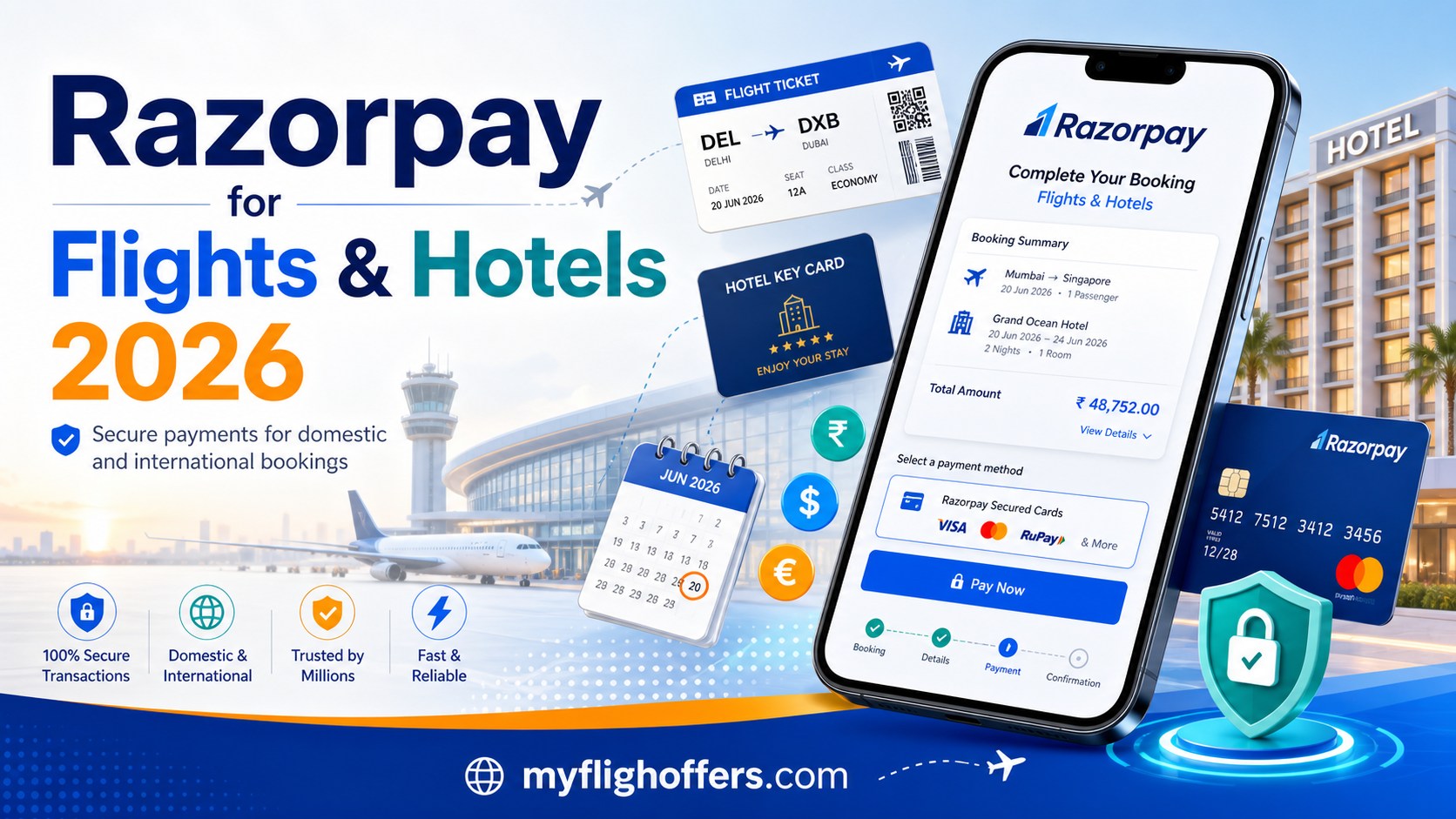
- Razorpay is a payment gateway — you never book directly on it. When you pay on an OTA like MakeMyTrip or Cleartrip, Razorpay processes the transaction behind the scenes; your booking confirmation comes from the OTA, not Razorpay.
- For cancellations and refunds, always contact the OTA first, not Razorpay. Razorpay has no visibility into booking records — the OTA initiates the refund and Razorpay processes it back to your original payment method.
- Failed payments that debit your account are covered by RBI auto-reversal rules. Money typically returns within T+2 business days — the guide explains exactly what to do if it doesn't appear within that window.
Razorpay is a payment gateway and payment aggregator, not a flight or hotel booking platform. You never book a flight directly on Razorpay. Instead, when you book on an OTA (MakeMyTrip, Cleartrip, Ixigo, Yatra), an airline's direct website, or a hotel booking engine that has integrated Razorpay - you encounter Razorpay's checkout page at the payment step. Razorpay processes your payment, routes the money to the merchant, and issues a transaction confirmation. Your booking confirmation always comes from the OTA or hotel - not from Razorpay. This distinction is important for understanding refunds, cancellations, and what to do when something goes wrong.
Quick answers
What is Razorpay?
RBI-authorised Payment Aggregator
PCI DSS Level 1 - 8 million+ businesses - Founded
2014
For domestic flights
Yes - UPI, cards, net banking, EMI, wallets
If the OTA you use has integrated Razorpay
For international flights
Yes - 100+ currencies, intl. cards
Visa, Mastercard, Amex, Diners from foreign banks
EMI available?
Yes - if the merchant enables it
Credit card, debit card, cardless EMI, Pay Later
In this guide - 15 questions answered
- What is Razorpay and how does it work for travel bookings?
- Can I pay for domestic flight tickets via Razorpay?
- Can I pay for international flight bookings via Razorpay?
- Can I book domestic hotels using Razorpay?
- Can I pay for international hotel stays via Razorpay?
- Which payment methods does Razorpay support for travel?
- Are international cards supported on Razorpay?
- Does Razorpay support INR and foreign currency payments?
- Is Razorpay safe for flight and hotel payments?
- What happens if a travel payment fails but money is debited?
- Are refunds available if a booking is cancelled?
- Can Razorpay reduce checkout drop-offs for travel sites?
- Does Razorpay support EMI or Pay Later for travel tickets?
- Is Razorpay useful for OTAs and hotel booking engines?
- What should users check before paying through Razorpay?
1. What Is Razorpay, and How Does It Work for Flight and Hotel Bookings?
Razorpay was founded in 2014 and is today India's largest full-stack payments and banking platform for businesses, trusted by over 8 million businesses. It is a licensed Payment Aggregator - a category regulated directly by the Reserve Bank of India. As an RBI-authorised PA, Razorpay can legally hold merchant funds in escrow, process customer payments, and settle money into business bank accounts. This regulatory backing is what separates it from payment gateways that only facilitate the transaction layer without touching funds.
For travel, Razorpay acts as the payment layer between the customer and the OTA, airline, or hotel. Here is the exact payment journey when you book a domestic flight on a Razorpay-powered travel portal:
- You select your flight and proceed to checkout on the OTA website or app.
- The checkout page opens - often branded as the OTA's own page but powered by Razorpay's payment infrastructure underneath.
- You select your payment method: UPI, card, net banking, EMI, wallet, or Pay Later.
- Razorpay encrypts your payment data immediately. Your card number never touches the OTA's server - Razorpay's tokenisation layer handles it.
- Razorpay sends an authorisation request through the card network (Visa/Mastercard/RuPay) to your issuing bank (e.g., HDFC, SBI, ICICI).
- Your bank authenticates you - via 3D Secure OTP for card payments, or via your UPI PIN for UPI. RBI mandates two-factor authentication for all transactions above Rs 5,000.
- Your bank approves or declines. If approved, Razorpay captures the payment and sends a success signal to the OTA.
- The OTA confirms your flight booking, issues the booking reference and e-ticket, and handles all post-booking communication. Razorpay's role is complete at this stage.
- Razorpay settles the transaction amount to the OTA's bank account on a T+1 to T+3 settlement cycle (standard domestic), or T+7 for international card transactions.
2. Can I Use Razorpay to Pay for Domestic Flight Tickets?
Yes - but with an important condition: the OTA or airline website you are booking through must have integrated Razorpay as its payment gateway. You cannot use Razorpay directly to book flights; you use it when the booking platform you are on has Razorpay at checkout.
Several Indian OTAs and airline booking engines use Razorpay or have used it at various points. If you see Razorpay's checkout modal (recognisable by the blue Razorpay logo and payment selection interface), all of the following domestic payment methods are available for flight bookings:
Razorpay charges the merchant (the OTA or airline website), not the customer, for most payment methods. Standard domestic card transactions are charged approximately 2% of the transaction value to the merchant. UPI transactions carry 0% MDR (Merchant Discount Rate) under the Indian government's mandate. Some OTAs pass the convenience fee to customers as a transparent line item - this is the OTA's decision, not Razorpay's. If you see a convenience fee at checkout, it is the OTA's add-on, not a Razorpay charge.
UPI for domestic flight bookings - practical limits
UPI supports two payment flows for domestic flight bookings via Razorpay. The Intent Flow automatically opens your UPI app (PhonePe, GPay, etc.) with payment details pre-filled - no VPA entry required, no manual app switching. This is the higher-success-rate path and is preferred on mobile. The Collect Flow requires you to enter your UPI ID manually and then approve the payment request in your bank's app.
3. Can I Use Razorpay to Pay for International Flight Bookings?
Yes. Razorpay's International Payment Gateway supports payments in over 100 foreign currencies and accepts international cards from foreign-issued Visa, Mastercard, American Express, and Diners Club cards. This means:
- An Indian OTA or airline website using Razorpay can charge a customer in USD, GBP, EUR, AED, SGD, or any of 100+ supported currencies.
- A foreign customer booking an India-origin international flight can pay in their home currency via an international card - the Indian merchant settles in INR.
- An Indian customer paying for an international flight priced in INR (as most Indian OTAs do) can use their Indian credit or debit card normally through Razorpay's standard checkout.
How international currency processing works on Razorpay
When a Razorpay-powered Indian travel website presents a fare in USD, EUR, or another foreign currency, the payment flow works as follows: the gateway locks a real-time forex exchange rate at the moment of checkout, the customer pays in their currency, and the Indian merchant's bank account receives the equivalent amount in INR after Razorpay's currency conversion. The merchant never receives foreign currency directly - all settlements to Indian businesses are in INR, as mandated by the RBI and FEMA regulations.
Local payment methods for international routes
For non-Indian customers booking on Indian travel portals, Razorpay supports select local payment methods from specific geographies, including Giropay (Germany), Sofort (European customers), and Trustly (UK and European customers). These allow foreign travellers to pay via their local bank transfer method without needing an international card. Availability depends on the specific merchant's Razorpay configuration.
4. Can I Book Domestic Hotels Using Razorpay?
Yes. In June 2025, RateGain - one of India's largest hotel technology and distribution platforms serving thousands of hotels - announced a strategic partnership with Razorpay, integrating Razorpay's payment infrastructure directly into RateGain's hotel booking engine. This integration brought the full Razorpay payment method suite to hotel direct booking across India, including UPI, mobile wallets, net banking, domestic and international credit and debit cards, EMI (via cards or cardless), and Pay Later solutions.
For guests, this means that hotels using RateGain's booking engine now offer the same broad payment flexibility as major OTAs. For hotels, Razorpay adds real-time transaction tracking, automated settlement reports, and centralised dashboards that simplify reconciliation - replacing manual bank statement matching.
Beyond RateGain, many independent hotel booking engines, resort websites, service apartment platforms, and hospitality management systems across India have integrated Razorpay independently. If you are booking directly on a hotel's website and see the Razorpay checkout interface, all standard payment methods apply.
The payment gateway (Razorpay or otherwise) does not affect your booking cancellation rights or refund eligibility. Your refund entitlement is governed by the hotel's cancellation policy, not by which gateway they use. What Razorpay does affect is which payment methods are available at checkout, how quickly refunds are processed once the hotel initiates them, and the security standards applied to your card data. A hotel using Razorpay benefits from PCI DSS Level 1 compliance - the highest tier - meaning your card data is handled to the most rigorous global security standard.
5. Can I Pay for International Hotel Stays with Razorpay?
This depends on the international hotel's booking platform and where it is domiciled. Razorpay is primarily designed for Indian businesses accepting payments. Here is how it works in different scenarios:
- Indian OTA booking an overseas hotel (e.g., MakeMyTrip booking a Dubai hotel for an Indian customer): If the OTA uses Razorpay, the customer pays in INR through Razorpay's standard checkout. The hotel pricing may be displayed in USD or AED but the customer's charge is in INR at the OTA's exchange rate. This is entirely normal and Razorpay handles it within its standard domestic or international gateway framework.
- Foreign hotel website booking (e.g., a London hotel's direct booking engine): Most overseas hotel websites will not use Razorpay - they typically use Stripe, Adyen, PayPal, or other globally distributed gateways. You would pay via credit card directly on their platform. Razorpay is not involved in this scenario.
- Non-Indian business accepting payments from Indian customers: Razorpay does offer a solution allowing foreign businesses to accept INR payments from Indian customers via Razorpay's infrastructure (UPI, cards, net banking), with settlement into the foreign business's overseas bank account. Supported settlement currencies include USD, SGD, AUD, CAD, EUR, GBP, HKD, INR, and MYR. This is relevant for international hotel groups with direct booking platforms targeting Indian travellers.
6. Which Payment Methods Does Razorpay Support for Travel Bookings?
Razorpay supports over 100 payment methods across India and internationally. For travel bookings specifically, the relevant methods are:
| Payment Type | Specific Methods | Best For | MDR / Fee to Merchant |
|---|---|---|---|
| UPI | PhonePe, GPay, BHIM, Paytm, WhatsApp Pay, any UPI app | Domestic bookings under Rs 1 lakh | 0% (government mandate) |
| Credit Cards | Visa, Mastercard, RuPay, American Express, Diners Club (Indian-issued) | Domestic and international, high-value bookings | ~2% |
| Debit Cards | All major Indian bank debit cards, RuPay | Domestic bookings, EMI-eligible cards | ~2% |
| Net Banking | 50+ Indian banks | Large domestic transactions; customers preferring bank login | ~1.5 - 2% |
| Credit Card EMI | HDFC, ICICI, SBI, Amex, Kotak, Axis, Yes, IndusInd and 10+ more | High-value bookings (international flights, holiday packages) | ~2% + EMI processing fee |
| Debit Card EMI | Select Indian banks with pre-approved EMI | Customers without credit cards wanting instalments | Bank-specific |
| Cardless EMI | Axio, EarlySalary, Instacred | Customers without cards - digital credit EMI | Provider-specific |
| Pay Later | LazyPay, Simpl, ICICI PayLater, HDFC FlexiPay, Amazon Pay Later | Zero-interest credit for 14-45 days | Provider-specific |
| Digital Wallets | Paytm, Mobikwik, FreeCharge, Airtel Money, Ola Money, PayZapp | Low-value ancillaries, add-ons | ~1.5% |
| International Cards | Visa, Mastercard, Amex, Diners (foreign-issued) | Foreign travellers, NRIs booking on Indian portals | ~3% |
| Corporate Cards | Business credit cards | Corporate travel bookings | ~3% |
| Apple Pay / Google Pay | For eligible international and mobile transactions | International customers on mobile devices | Varies |
No Cost EMI means the customer pays zero interest on the EMI instalments. The interest cost is subsidised - either by the OTA merchant (who pays Razorpay a subvention fee) or by the card-issuing bank as part of a promotional offer. Razorpay's dashboard allows merchants to create No Cost EMI offers without any coding. For the customer, the booking cost is split into equal instalments at zero additional charge. The merchant receives the full amount upfront from Razorpay. Instant Refunds are not available on EMI, Cardless EMI, or Pay Later - standard bank timelines apply if a refund is needed.
7. Are International Cards Supported on Razorpay for Travel Payments?
Yes. International cards - credit and debit cards issued by banks outside India - are supported on Razorpay's International Payment Gateway feature. Supported networks for international cards are:
- Visa (international)
- Mastercard (international)
- American Express (international)
- Diners Club (international)
International card transactions are charged to the merchant at approximately 3% (compared to ~2% for standard Indian domestic cards). This is an industry-standard differential reflecting higher processing costs for cross-border card transactions.
NRI-specific consideration
NRI travellers booking India-route flights from abroad using a foreign-issued card will be processed as an international transaction on Razorpay, attracting the 3% merchant fee. Your card-issuing bank may also apply its own foreign transaction fee (typically 1.5-3.5%) on top of the currency conversion. To minimise total cost, NRIs should use cards with low or zero foreign transaction fees - refer to our HDFC cards guide, SBI cards guide, or ICICI cards guide for the best low-markup card options.
8. Does Razorpay Support INR and Foreign Currency Payments for Travel Bookings?
Yes, with important nuances depending on which direction the payment flows.
Indian business accepting payments from Indian customers (domestic)
All transactions are in INR. UPI, net banking, wallets, and Indian-issued cards all operate natively in INR. No forex conversion occurs. Settlement to the merchant's Indian bank account is in INR on a standard T+1 to T+3 cycle.
Indian business accepting payments from international customers (inbound)
Razorpay supports over 100 foreign currencies for inbound international payments. The customer pays in their local currency - the merchant always receives INR. Razorpay handles the currency conversion at a real-time exchange rate locked at the moment of checkout. Settlement in INR occurs on a T+7 working day cycle for international transactions. The FIRC (Foreign Inward Remittance Certificate) required under FEMA regulations is automatically generated and available for download from the Razorpay dashboard - no manual effort required.
Non-Indian business accepting payments from Indian customers (outbound)
Foreign businesses can use Razorpay to accept INR payments from Indian customers (via UPI, cards, net banking) and settle the funds in their overseas bank account in their local currency. Supported settlement currencies: USD, SGD, AUD, CAD, EUR, GBP, HKD, INR, and MYR. This is relevant for international airline websites or hotel groups wanting to accept Indian payment methods without establishing a local Indian entity.
| Scenario | Customer Pays In | Merchant Receives | Settlement Time |
|---|---|---|---|
| Indian OTA, Indian customer, domestic flight | INR (UPI/card/netbanking) | INR | T+1 to T+3 |
| Indian OTA, Indian customer, international flight priced in INR | INR | INR | T+1 to T+3 |
| Indian OTA, foreign customer, international flight in USD/EUR/GBP | Foreign currency (100+ supported) | INR (converted) | T+7 |
| Foreign hotel, Indian customer, booking in INR | INR | Foreign currency (USD/GBP/EUR etc.) | Varies by agreement |
9. Is Razorpay Safe for Booking Flights and Hotels Online?
Razorpay is one of the most secure payment infrastructure providers in India. Its security architecture covers four layers that are relevant for travel payment users:
Layer 1 - Regulatory compliance
Razorpay is an RBI-authorised Payment Aggregator - a designation that requires it to pass stringent due diligence, maintain customer funds in escrow with RBI-approved banks, and comply with the RBI's Payment Aggregator Master Directions (last updated September 2025). This regulatory framework means customer funds are protected even if the merchant has operational difficulties.
Layer 2 - PCI DSS Level 1 certification
PCI DSS (Payment Card Industry Data Security Standard) Level 1 is the highest tier of global card security certification. Achieving Level 1 requires an annual on-site assessment by a Qualified Security Assessor, quarterly network scans, and penetration testing. Razorpay holds this certification, meaning:
- Your card data is encrypted at the point of entry before it leaves your browser
- Card numbers are tokenised - replaced with non-sensitive tokens - so the OTA's server never receives or stores your raw card number
- All transmission between your browser, Razorpay, and the card network occurs over encrypted HTTPS/TLS connections
Layer 3 - 3D Secure 2.0 authentication
All card transactions above Rs 5,000 require two-factor authentication - mandated by the RBI. Razorpay implements 3D Secure 2.0 (3DS2), which is a risk-based authentication upgrade over the older 3DS1. Low-risk transactions (familiar device, normal spending pattern, recognised location) pass frictionlessly without an OTP. High-risk or unfamiliar transactions trigger the full OTP verification step. This reduces checkout friction for returning customers while maintaining security.
Layer 4 - Thirdwatch AI fraud detection
Razorpay's in-house fraud detection engine, Thirdwatch, uses machine learning to analyse hundreds of data points per transaction in real time: device ID, IP address geolocation, session behaviour, transaction velocity, card BIN patterns, and historical fraud signals. Suspicious transactions are flagged or blocked before authorisation. This is especially relevant for travel payments - high-value airline and hotel bookings are known targets for stolen card fraud.
Razorpay itself is highly secure. The genuine risk in travel payments comes from the legitimacy of the merchant website using Razorpay. Any business can apply for a Razorpay account (subject to KYC and RBI-mandated due diligence). A scam travel website could technically use Razorpay and still defraud customers by not fulfilling a booking. Always verify the travel website's legitimacy independently before entering payment details - check for HTTPS, a verifiable business address, legitimate contact information, and customer reviews on independent platforms. The presence of Razorpay at checkout confirms the payment is processed securely, but it does not guarantee the merchant is a legitimate travel business.
10. What Happens If a Travel Payment Fails But Money Is Debited?
This is one of the most stressful situations in online travel booking - and one of the most common support queries. Understanding exactly what happens technically will help you respond correctly.
Why does money get debited when a payment fails?
A payment can be in one of several states: authorised (bank has approved and held the funds), captured (merchant has confirmed and received the funds), or failed (no successful confirmation received from the bank). The confusion arises because your bank may debit your account at the authorisation stage - before Razorpay receives the final capture confirmation. If the network connection between Razorpay and the acquiring bank times out, or if the OTA's system cannot confirm seat availability within the payment window, the payment is marked failed even though your bank has already placed a hold on the funds.
From Razorpay's official documentation: "If the customer's account is debited and we do not receive a successful callback, the amount will be auto-refunded by the customer's issuing bank in T+7 working days." Razorpay also continuously polls the acquiring bank at regular intervals after a failure - if the status changes to successful, it notifies the merchant, who can then either fulfil the booking or initiate a refund.
Step-by-step: what to do if your money is debited but booking is not confirmed
- Do not re-attempt the payment immediately. If your bank account was debited, a second attempt could result in a double charge. Wait at least 30 minutes and check both your bank balance and your booking confirmation email.
- Check your booking status on the OTA or airline website. Log in and check your bookings section. In many cases, the booking is actually confirmed even if you did not see a success screen - the confirmation may arrive via email within minutes.
- Contact the OTA or hotel first - not Razorpay. The merchant (OTA or hotel) is your primary point of contact. They have access to the order status linked to your payment reference and can confirm whether the booking was completed. They can also initiate the refund if needed.
- Get your transaction/payment reference number from your bank's SMS or app for the debited amount. Share this with the OTA when raising a complaint.
- If the OTA cannot resolve it, raise a ticket with Razorpay's support directly at razorpay.com/support/#refund using your transaction details.
- If the auto-refund does not arrive within 10 working days, contact your bank's customer care and raise a dispute / chargeback claim, citing the failed transaction date and reference number.
11. Are Refunds Available If a Flight or Hotel Booking Is Cancelled After Paying Through Razorpay?
Yes - but the refund eligibility, amount, and timeline depend on the travel merchant's cancellation policy, not on Razorpay. Razorpay is the payment infrastructure. Whether you get a full, partial, or no refund is determined entirely by the OTA or hotel's terms and conditions.
How refunds work on Razorpay-powered bookings
Once you request a cancellation through the OTA or hotel, and once they approve the refund per their policy, the merchant initiates a refund from their Razorpay dashboard. Razorpay processes it back to your original payment source:
| Payment Method Used | Typical Refund Timeline | Instant Refund Available? |
|---|---|---|
| Credit Card (domestic) | 5-7 working days after merchant initiates | No - standard bank cycle |
| Debit Card (domestic) | 5-7 working days | No |
| UPI | 2-5 working days | Sometimes - Razorpay Instant Refunds enabled on UPI where supported |
| Net Banking | 5-7 working days | No |
| EMI (Credit Card) | 5-7 working days + EMI close-out | No - Instant Refunds NOT supported on EMI |
| Cardless EMI | Provider-specific - up to 10-14 days | No - Instant Refunds NOT supported |
| Pay Later (LazyPay, Simpl) | Provider-specific | No - Instant Refunds NOT supported |
| Wallet | 2-3 working days (to wallet balance) | Typically faster than cards |
| International Card | 7-14 working days | No |
What if the OTA or hotel refuses to initiate a refund you believe you are entitled to?
Razorpay cannot override a merchant's refund decision - it is the payment processor, not the booking platform. Your options in a dispute are: (1) raise a formal complaint with the OTA or hotel's grievance officer; (2) file a complaint with the National Consumer Disputes Redressal Commission (NCDRC) or your state's consumer forum; (3) raise a chargeback with your card-issuing bank (available for credit and debit card payments - banks typically require a chargeback request within 60-120 days of the transaction date, varying by bank). A chargeback bypasses the merchant and asks the card network to reverse the transaction.
12. Can Razorpay Help Reduce Checkout Drop-offs During Flight and Hotel Bookings?
This question is aimed at travel businesses and OTAs, not individual travellers. The answer is: yes, significantly - and this is one of the primary reasons travel portals integrate Razorpay rather than building their own payment processing.
India's online travel checkout has a severe drop-off problem. An estimated 85% of mobile shopping carts in India are abandoned before payment, driven by slow load times, complex checkout forms, limited payment options, and network failures - particularly in Tier 2 and Tier 3 cities. For travel platforms where high-value bookings are the norm, even a 5% improvement in checkout conversion can translate to crores of additional revenue annually.
Razorpay's travel-specific checkout tools
- Magic Checkout: Razorpay's one-click checkout product. Pre-fills customer name, contact, and billing details from saved profiles across the Razorpay merchant network. A first-time visitor to an OTA who has previously transacted on any other Razorpay-enabled site may find their details pre-filled. Delivers up to 30% higher conversion rates and 50% faster checkout times in merchant testing.
- UPI Intent Flow: Automatically switches to the customer's preferred UPI app without requiring them to enter a VPA. The payment request is pre-populated. This eliminates the manual entry and context-switching that causes drop-offs on UPI payments. Razorpay reports significantly higher UPI success rates with Intent Flow versus Collect Flow.
- Intelligent Routing: Razorpay's in-house card switch evaluates multiple payment processing paths in real time and selects the one with the highest approval probability. Delivers up to 10% higher card success rates. For high-value international flight bookings where card declines are common, this is particularly valuable.
- Smart Retry: When a primary payment method fails, Razorpay automatically suggests alternative payment paths. "Try again" logic doubles conversion from ~2% to ~4% after initial payment declines - recovering bookings that would otherwise be lost.
- Affordability Widget: Displays EMI, No Cost EMI, and Pay Later options on the product/search page - not just at checkout. For a Rs 40,000 international flight displayed with "Rs 6,600/month over 6 months, No Cost EMI from HDFC Bank," the purchase decision changes before the customer even reaches checkout. This reduces cart abandonment driven by sticker shock on large fares.
- Capture Settings for seat holds: Travel portals can configure how long a payment can be held before the seat is released. A 20-minute capture timeout prevents the scenario where a seat is held but the customer's payment times out - reducing both customer frustration and inventory management issues.
- Route (split payments): For OTAs handling bookings that span multiple vendors (flight + hotel + transfer), Razorpay Route allows a single customer payment to be automatically split and settled to multiple vendor accounts with configurable commission logic. This removes the operational complexity of multi-vendor settlement from the OTA's internal systems.
- Smart Collect: Creates virtual bank accounts and UPI IDs for automated payment tracking and reconciliation. For OTAs with high booking volumes, this replaces manual bank statement matching with automated transaction matching.
13. Does Razorpay Support EMI or Pay Later for Flight and Hotel Tickets?
Yes. Razorpay's Affordability Suite covers all major EMI and Pay Later options available in India. Here is the complete breakdown for travel:
Credit Card EMI
Available from 15+ card-issuing banks including HDFC Bank, ICICI Bank, SBI Card, Axis Bank, Kotak Mahindra Bank, Yes Bank, IndusInd Bank, RBL Bank, Bank of Baroda, American Express, and Standard Chartered. Tenures typically range from 3 to 24 months. Standard interest rates are charged by the bank. No Cost EMI (zero interest) is available where the merchant has set up a subvented offer on the Razorpay dashboard - common on major OTAs during peak booking seasons.
Debit Card EMI
Available from select Indian banks with pre-approved debit card EMI programmes. The customer's eligibility is checked in real time at checkout based on the card number and registered phone number. No down payment required. Debit card EMIs can be foreclosed after the first three EMIs. Note: the merchant must have Debit Card EMI explicitly enabled - not all travel sites have done so.
Cardless EMI
A 100% digital EMI option for customers without a credit or debit card. Available via Axio (formerly ZestMoney), EarlySalary, and Instacred. Customers are approved based on digital credit criteria (not a traditional credit card). This makes international flight EMI accessible to a much wider audience, including customers in Tier 2 and Tier 3 cities who may not hold credit cards.
Pay Later (BNPL)
Pay Later allows customers to complete a booking now and pay within 14-45 days at zero interest (period varies by provider). Available via LazyPay, Simpl, ICICI PayLater, HDFC FlexiPay, and Amazon Pay Later. To use, the customer must be registered and pre-approved with the relevant Pay Later provider before attempting checkout. Pay Later is particularly useful for last-minute flight bookings where a customer needs a seat now but won't be paid until later in the week or month.
At Razorpay checkout, when a customer selects EMI or Pay Later, Razorpay automatically checks their eligibility in real time - based on the card number, registered phone number, or digital credit profile - and shows only the options they are eligible for. If a customer is not eligible for cardless EMI, they will not see it as an option. Razorpay aggregates all eligibility checks into a single step, so the customer does not need to know in advance which provider they qualify for.
| EMI Type | Providers | Card Required? | No Cost EMI? | Instant Refund? |
|---|---|---|---|---|
| Credit Card EMI | 15+ banks incl. HDFC, ICICI, SBI, Amex | Yes (credit card) | Where offered by merchant | No |
| Debit Card EMI | Select Indian banks | Yes (debit card) | Bank-dependent | No |
| Cardless EMI | Axio, EarlySalary, Instacred | No | Provider-dependent | No |
| Pay Later (BNPL) | LazyPay, Simpl, ICICI, HDFC FlexiPay, Amazon | No | Zero interest 14-45 days | No |
14. Is Razorpay Useful for Travel Websites, OTAs, or Hotel Booking Engines?
Yes - and the travel sector is one of Razorpay's primary verticals. India's travel and hospitality sector is projected to reach $125 billion by 2027, with over 70% of hotel bookings expected to be made digitally (per Razorpay COO Rahul Kothari, June 2025). Razorpay offers several features specifically relevant to travel businesses:
For OTAs (Online Travel Agencies)
- Multi-method checkout: Single integration covers 100+ payment methods - UPI, cards, net banking, wallets, EMI, Pay Later - without separate integrations per method.
- Route (multi-vendor split): Automatically splits a single booking payment across multiple vendors (airline, hotel, transfer) with configurable commission structures and settlement logic.
- Intelligent Routing + Smart Retry: Maximises payment success rates across high-value international bookings where card declines are frequent.
- Smart Collect: Virtual accounts for automated reconciliation across thousands of daily bookings.
- International payment acceptance: Serve global travellers without separate gateway integrations for different countries.
- Instant Settlement: Access funds outside the standard settlement window on demand - important for managing cash flow during high-volume booking periods.
For hotel booking engines
- RateGain integration: Hotels using RateGain's booking engine have native Razorpay support as of June 2025 - no separate Razorpay integration required.
- PCI DSS Level 1 compliance by default: Hotels do not need to pursue independent PCI certification - Razorpay handles the compliance layer, significantly reducing risk and administrative burden.
- Real-time transaction tracking and automated settlement reports: Replaces manual reconciliation with a centralised dashboard.
- Razorpay POS: For hotel front-desk in-person payments, Razorpay's POS terminals accept cards and UPI - creating a unified payment infrastructure for both online and offline hotel transactions.
Travel business classification - what to know
15. What Should Users Check Before Paying for a Flight or Hotel Through Razorpay?
For individual travellers, here is a practical pre-payment checklist:
- Verify the website URL is legitimate. The presence of Razorpay's checkout confirms secure payment processing - it does not confirm the merchant is a legitimate travel business. Check the OTA or hotel URL carefully (look for HTTPS, correct domain spelling). Compare fares on a second trusted platform before booking on an unfamiliar site.
- Check the refund and cancellation policy before paying. Every travel merchant has different cancellation terms. A non-refundable fare paid via EMI creates a complicated situation - you cannot reverse the EMI but may not get the fare back. Always read the cancellation terms on the specific fare or room rate, not just the OTA's general policy.
- Choose your payment method based on flexibility, not just habit. UPI and standard card payments give you the cleanest refund path if you need to cancel - refunds go directly to your original payment source. EMI, Cardless EMI, and Pay Later do not support instant refunds, and the refund process for cancelled EMI bookings involves the lending partner, not just the OTA.
- For bookings above Rs 1 lakh, UPI may not work. NPCI's Rs 1 lakh per-transaction UPI limit applies to standard UPI payments. Use a credit card or net banking for high-value international flight bookings to avoid UPI limit rejections at checkout.
- Ensure 3D Secure is enabled on your card. ICICI Bank, HDFC Bank, SBI, and all major Indian banks have 3D Secure OTP enabled by default. If you have disabled it or are using an older card that does not support it, card transactions via Razorpay may be declined. Enable international transactions on your card via your bank's app before booking if you are paying for an internationally-priced fare.
- Note your transaction reference number immediately after payment. Whether the booking succeeds or fails, the Razorpay payment reference (visible in the transaction confirmation or SMS from your bank) is your primary reference for any follow-up with the OTA, hotel, or Razorpay support.
- Do not refresh or close the browser mid-transaction. During UPI or net banking payment, navigating away from the Razorpay payment page before the confirmation screen appears can interrupt the payment capture - causing the "money debited, booking not confirmed" scenario. Wait for the confirmation page or app notification before closing any window.
- For EMI bookings, understand the foreclosure process before you book. If you cancel a booking paid via credit card EMI, the EMI is not automatically cancelled - you must separately request EMI foreclosure from your bank. Some banks charge a foreclosure fee. The refund from the merchant and the EMI closure are two separate actions.
Razorpay at a Glance - Key Facts for Travel Payments (2026)
| Fact | Detail |
|---|---|
| Founded | 2014, Bengaluru, India |
| Regulatory status | RBI-authorised Payment Aggregator |
| Security certification | PCI DSS Level 1 (highest tier) - SOC 3 certified |
| Businesses served | 8 million+ as of 2026 |
| Payment methods | 100+ including UPI, cards, net banking, wallets, EMI, Pay Later |
| Currencies supported | 100+ foreign currencies for inbound international payments; 160+ currencies for outbound |
| International card networks | Visa, Mastercard, Amex, Diners (domestic and international) |
| UPI success rate | 90%+ reported by Razorpay |
| International card success rate | 90-95% across 135 currencies (Razorpay reported) |
| Standard domestic card fee | ~2% of transaction value (charged to merchant) |
| International/Amex/Diners/Corporate card fee | ~3% (charged to merchant) |
| UPI fee | 0% MDR (government mandate) |
| Failed payment auto-refund | T+7 working days from issuing bank |
| EMI/Pay Later refund | Standard bank timelines - Instant Refund NOT supported |
| Settlement to Indian merchants | INR only; T+1 to T+3 (domestic), T+7 (international) |
| Travel sector partnership | RateGain hotel booking engine (June 2025) |
| Fraud detection engine | Thirdwatch - AI/ML real-time fraud scoring |
| Authentication standard | 3D Secure 2.0 (risk-based, reduces unnecessary OTP friction) |
| RBI compliance | Card tokenisation, data localisation, 2FA mandate, PA Master Directions (Sep 2025) |
Razorpay processes your payment - your credit or debit card choice determines what rewards you earn, what forex markup you pay, and how much you effectively save on every booking. Compare your options:
- Card Tokenization India 2026: What the RBI "Secure Your Card" Checkbox Actually Does - RBI card on file tokenization, checkout flow, refund impact, and myths debunked
- Axis Bank Credit Cards for Flight Bookings 2026 - EDGE Miles vs EDGE Reward Points, Atlas vs Magnus, and April 2026 partner changes
- Kotak Bank Credit Cards for Flight Bookings 2026 - Air+, Air, IndiGo Kotak, Kotak Unbox and transfer-partner strategy
- Best HDFC Bank Cards for Flights & Travel 2026 - SmartBuy 10X rewards, Infinia, Regalia Gold, and the HDFC ForexPlus card
- Best SBI Credit Cards for Flights & Travel 2026 - Miles Elite, KrisFlyer SBI, IndiGo SBI, and IRCTC SBI
- Best ICICI Bank Credit Cards for Flights & Travel 2026 - Emeralde Private Metal, MakeMyTrip ICICI (0.99% forex), Emirates Skywards, and iShop rewards
- Paytm Explained 2026 - UPI, Payments Bank, Safety & Limits - What still works after the PPBL closure, UPI limits, NRI support, and Paytm vs GPay vs PhonePe
- PhonePe for Flight Bookings 2026 - Complete Guide - ixigo integration, UPI limits, refunds, and NRI UPI setup
Frequently Asked Questions
What is Razorpay and how does it work for flight and hotel bookings?
Razorpay is an RBI-authorised Payment Aggregator and full-stack payments platform used by businesses - including OTAs, airlines, and hotel booking engines - to process customer payments online. When you book a flight on MakeMyTrip, Cleartrip, Ixigo, Yatra, or a direct hotel website that uses Razorpay, you interact with Razorpay's payment checkout page at the point of payment. Razorpay itself is not a travel booking platform - it is the payment infrastructure that powers the checkout. It encrypts your payment data, authorises your card or UPI payment, and settles the funds to the merchant. The booking confirmation comes from the OTA or hotel, not from Razorpay.
Can I use Razorpay to pay for domestic flight tickets in India?
Yes. If the OTA or airline website you are booking through uses Razorpay as its payment gateway, you can pay for domestic flight tickets using any Razorpay-supported payment method: UPI (PhonePe, GPay, Paytm, BHIM, WhatsApp Pay), credit and debit cards (Visa, Mastercard, RuPay, Amex, Diners), net banking (50+ Indian banks), EMI (credit card EMI from 15+ banks, debit card EMI from select banks, cardless EMI), Pay Later services (LazyPay, Simpl, ICICI PayLater, HDFC FlexiPay), and digital wallets (Paytm, Mobikwik, FreeCharge, Airtel Money, Ola Money, PayZapp). UPI carries zero MDR (merchant discount rate) by government mandate. Standard domestic card rates are approximately 2% of the transaction value, charged to the merchant, not to the customer.
Can I use Razorpay to pay for international flight bookings?
Yes, if the travel website uses Razorpay's International Payment Gateway. Razorpay supports over 100 foreign currencies and accepts international cards issued by foreign banks on Visa, Mastercard, American Express, and Diners Club networks. International card transactions are charged to the merchant at approximately 3% (versus 2% for standard domestic cards). The customer pays in their local currency (e.g., USD, GBP, EUR), and the Indian merchant settles in INR. For Indian customers booking international flights priced in foreign currencies on Indian OTAs using Razorpay, the payment is processed in INR with any forex conversion handled at the platform level.
What happens if a travel payment fails but money is debited from my account?
If your account is debited but Razorpay does not receive a successful payment confirmation from the issuing bank, your money sits in a suspense account. Razorpay polls the acquiring bank at regular intervals. If the payment status updates to successful, the merchant is notified and can provide the service or initiate a refund. If the payment remains failed, the amount is auto-refunded by your issuing bank within T+7 working days (approximately 7 - 10 business days). You should contact the travel merchant (the OTA or hotel) first - they can confirm order status and initiate the refund process if needed. Track your refund status at razorpay.com/support/#refund using your transaction ID.
Are refunds available if a flight or hotel booking is cancelled after paying through Razorpay?
Refund eligibility depends on the travel merchant's cancellation policy, not Razorpay's. Razorpay is the payment processor - the OTA or hotel controls whether and how much is refunded. Once the merchant initiates a refund via the Razorpay dashboard, the amount is credited to your original payment source. For card and UPI payments, refunds typically take 5 - 7 working days after the merchant initiates them. Important: Instant Refunds are NOT supported on EMI, Cardless EMI, or Pay Later transactions - these refunds follow standard bank timelines.
Does Razorpay support EMI or Pay Later for flight and hotel tickets?
Yes, if the OTA or hotel website has enabled these options on their Razorpay integration. Credit Card EMI is available from 15+ banks including HDFC, ICICI, SBI, Amex, and more. Debit Card EMI is available from select banks. Cardless EMI (no card required) is available via Axio, EarlySalary, Instacred, and others. Pay Later (buy now, pay in 14 - 45 days at zero interest) is available via LazyPay, Simpl, ICICI PayLater, HDFC FlexiPay, and Amazon Pay Later. The merchant must specifically enable these options on their Razorpay dashboard. If you don't see EMI at checkout, the specific OTA or hotel has not activated it.
Is Razorpay safe for booking flights and hotels online?
Yes. Razorpay is an RBI-authorised Payment Aggregator, holds PCI DSS Level 1 certification (the highest tier globally), and is used by over 8 million Indian businesses. It supports 3D Secure 2.0 authentication for card payments (mandatory for transactions over Rs 5,000 per RBI rules), uses end-to-end encryption and card tokenisation (raw card numbers are never stored on merchant servers), and runs Thirdwatch - its in-house AI-powered fraud detection engine. The risk in travel payments comes not from Razorpay itself but from the legitimacy of the merchant website using Razorpay. Always verify the website URL before entering payment details.
Ready to find your flight?
Now you know how your payment will be processed. Compare live fares on your route and use the best card at checkout for maximum savings.
All technical details, payment method lists, transaction fee rates, security certifications, refund timelines, currency support, and product features described in this article are based on publicly available information from Razorpay's official website (razorpay.com), Razorpay's developer documentation (razorpay.com/docs), Razorpay's official blog posts, the RateGain partnership announcement (June 2025), and third-party developer and merchant community sources as of May 2026. Razorpay's product features, fee structures, supported payment methods, and merchant terms may change without notice. Always verify current details at razorpay.com before making integration or payment decisions. MyFlightOffers is not affiliated with Razorpay Software Private Limited. This article does not constitute financial or legal advice. Razorpay's services are directed at businesses - individual consumers encounter Razorpay's technology through merchant-operated websites and apps.