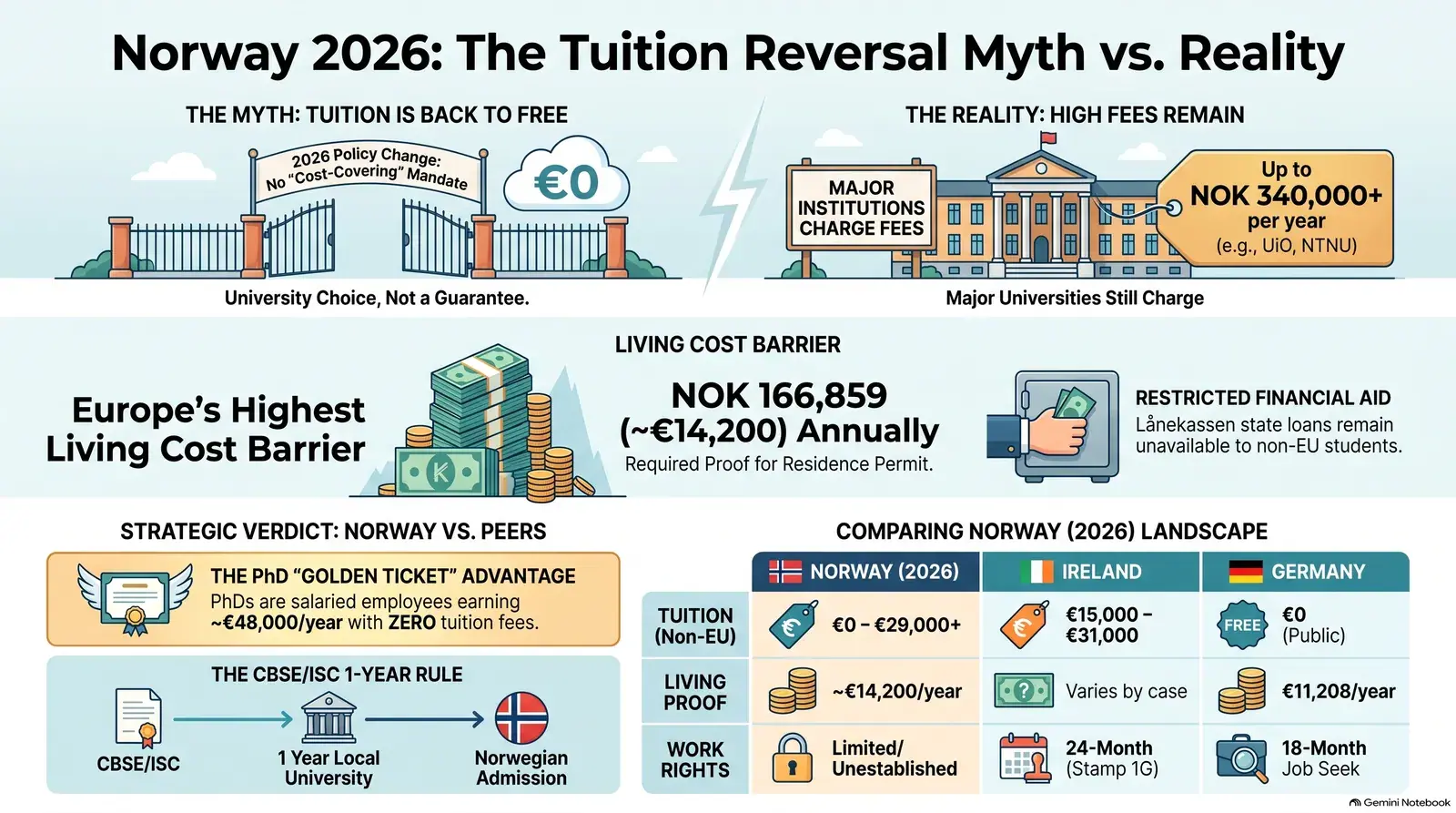
- The reversal is real but partial: Norway removed the legal requirement for universities to charge cost-covering tuition from 1 August 2026, but universities decide individually — and the biggest ones (UiO, NTNU, UiB) are still charging NOK 130,000–340,000+ per year for non-EU students in 2026/27.
- Living costs remain brutal: Average student monthly expenses in Norway are approximately NOK 14,700 (€1,250), and the UDI requires proof of NOK 166,859 per year for a student visa — the highest living-cost proof requirement among major European study destinations.
- Ireland still wins on post-study work: Norway's post-study work pathway is significantly less established than Ireland's 24-month Stamp 1G, and Lånekassen student loans are unavailable to non-EU/EEA nationals including Indian students.
1 August 2026 (university autonomy to set zero fees)
Still charging — NOK 130,000–340,000+/year for non-EU
NOK 166,859/year (€~14,200) required by UDI
Yes — fully salaried at NOK 550,800–575,400/year
In this guide
- What actually changed: Norway's 2023 fee shock and the 2026 reversal
- The critical nuance: universities can charge, most still do
- UiO, NTNU, UiB, and Nord University: fees and programmes compared
- Norway vs Ireland vs Germany: the full comparison for Indian students
- Scholarships and Lånekassen: what funding is actually available
- How to apply from India: requirements, English programmes, and visa
- Frequently asked questions
- Verdict: is Norway worth choosing over Ireland in 2026?
What actually changed: Norway's 2023 fee shock and the 2026 reversal
Norway introduced tuition fees for non-EU/EEA and Swiss students in August 2023, the first time in the country's history that public university education was not free regardless of nationality. The Storting (Norwegian parliament) voted 86 to 11 in favour of the change in June 2023. Universities were required to set fees at a "cost-covering" level, meaning they had to recover the full institutional cost of educating an international student — which translated to annual fees of NOK 130,000 to over NOK 340,000 depending on the institution and programme.
The impact was immediate and severe. According to data from the Norwegian Directorate of Immigration (UDI), visa applications from outside the EEA fell approximately 45 percent within the first months of the policy. By 2024, broader enrolment figures showed non-EEA degree student numbers had collapsed by roughly 80 percent compared to pre-fee levels. Programmes at universities in Bergen, Tromsø, and Trondheim that had previously attracted hundreds of applicants from Asia, Africa, and Latin America found themselves with only a handful of new enrolments. The policy also made Norway effectively uncompetitive against Germany (where public university education remains free for all students), the Netherlands, and France.
The political reversal came in June 2025 when Norway's Ministry of Education and Research announced a legislative proposal to remove the cost-covering requirement entirely. The bill passed and came into force on 1 August 2026. Crucially, it does not reimpose free education as the default — it gives universities and university colleges (høyskoler) the legal right to set fees at any level they choose, including zero. The change is enabling legislation, not a mandate.
- August 2023: Non-EU tuition fees introduced at cost-covering levels (NOK 130,000–340,000+/year). International enrolment collapses by ~80%.
- June 2025: Norwegian Ministry of Education announces bill to remove cost-covering requirement, enabling universities to set fees to zero.
- 1 August 2026: Bill comes into force. Universities can now choose their own fee level — but are under no obligation to set it to zero.
The critical nuance: universities can charge, most still do
The most important thing to understand about Norway's 2026 fee reversal is that it removes the legal floor, not the fees themselves. Each public university and university college independently decides whether to charge non-EU students and at what level. As of August 2026, the majority of Norway's research-intensive universities are still charging fees for 2026/27 enrolment.
This matters because most headlines covering the reversal say things like "Norway makes university free again" or "Norway restores free education" — which is accurate at the system level (the law no longer requires fees) but misleading at the student level (the universities you are most likely to want to attend are still charging). The institutions most in demand — the University of Oslo (UiO), the Norwegian University of Science and Technology (NTNU), and the University of Bergen (UiB) — have confirmed that non-EU students will continue paying tuition in the 2026/27 academic year.
UiO, NTNU, UiB, and Nord University: fees and programmes compared
Here is a direct comparison of what non-EU students actually pay at Norway's major universities for 2026/27, alongside the programme types they are most known for:
| University | Non-EU Fee Status 2026/27 | Annual Fee Range (NOK) | Annual Fee Range (EUR approx.) | Known For |
|---|---|---|---|---|
| University of Oslo (UiO) | Still charging | NOK 68,000–98,000/semester (master's level) | €5,800–8,400/semester | Law, humanities, social sciences, medicine |
| NTNU Trondheim | Still charging | NOK 176,300/year (Category 1: humanities, social sciences, economics) | €15,000/year | Engineering, technology, natural sciences, architecture |
| University of Bergen (UiB) | Still charging | NOK 130,000–220,000/year (programme-dependent) | €11,000–18,700/year | Marine biology, fisheries, social anthropology, law |
| Nord University | Reducing fees from 2026/27 (conditional on final board approval) | NOK 85,000/year (2025/26); lower for 2026/27 | €7,200/year (2025/26) | Business administration, nursing, education, aquaculture |
| UiT — The Arctic University of Norway | Ambiguous — verify directly with admissions | Conflicting published figures; contact admissions | — | Arctic studies, law (only Norwegian-language LLB), fisheries, health |
The semester fee (semesteravgift) is charged to all students regardless of nationality and typically runs NOK 700–1,000 per semester. It covers student welfare services, the student union, and public transport passes at some institutions. This fee is separate from tuition and remains payable even at universities that move to zero tuition for non-EU students.
On-the-Ground Insight: "I received an offer from NTNU for the MSc in Industrial Ecology in early 2026. The fee was listed at NOK 176,300 for the year — which is actually cheaper than what I was quoted at my second-choice programme in the Netherlands. But when I added accommodation, food, and the visa proof-of-funds requirement, the total first-year cost came out higher than Ireland. The tuition saving was not as dramatic as I expected." — Riya M., NTNU Trondheim, MSc Industrial Ecology, intake August 2026
Norway vs Ireland vs Germany: the full comparison for Indian students
When evaluating Norway as a study destination for Indian master's students, it needs to be compared against the two alternatives most likely to be on the same shortlist: Ireland (particularly for English-language programmes and Indian professional networks) and Germany (the dominant zero-tuition European option). The differences are significant across tuition, living costs, post-study work, and PhD pathways.
| Factor | Norway | Ireland | Germany |
|---|---|---|---|
| Tuition (non-EU master's) | NOK 0 to 340,000+/year (€0–29,000+) depending on university — most major universities still charge | €15,000–31,000/year at public universities for non-EU | €0 tuition at public universities in 15 of 16 states; semesterbeitrag €150–400 |
| Monthly living costs | NOK 13,000–15,000/month in Oslo (€1,100–1,280); NOK 11,500–13,500 elsewhere | €1,200–1,800/month (Dublin €1,500–1,800; Cork/Galway €1,100–1,400) | €850–1,200/month (Munich higher, Dresden/Leipzig lower) |
| Post-study work rights | Limited; no established graduate job-seeking permission equivalent to Ireland's Stamp 1G | 24 months (Stamp 1G for NFQ Level 9 master's graduates) — full work rights with no employer constraint | 18 months after graduation to job-seek; strong labour market in engineering and IT |
| PhD pathway | Fully salaried employment at NOK 550,800–575,400/year (€47,000–49,000); open to all nationalities; no tuition — outstanding option | Funded positions available but stipend-based (typically €18,500–22,000/year); full employment rights on Stamp 2 with research exception | Salaried TVöD positions at €27,000–35,000/year; strong research infrastructure |
| Indian student community | Small; infrastructure for Indian students (groceries, community, professional networks) is limited | Large; Dublin has established Indian professional, cultural, and student networks across tech, pharma, and finance sectors | Growing; strong Indian communities in Munich, Berlin, Stuttgart, and Frankfurt |
| Language of instruction | English-language master's programmes exist but are fewer in number; most bachelor's programmes are in Norwegian | All programmes at Irish public universities are in English | English-medium master's programmes available but bachelor's overwhelmingly in German |
| Proof of funds for visa | NOK 166,859/year (€~14,200) — must be deposited or verified | No fixed minimum required but sufficient funds for fees and living must be demonstrated | €11,208/year blocked account (Sperrkonto) required |
| Lånekassen / student loan access | Not available to non-EU/EEA students | Not applicable (SUSI grants for EU/EEA only; Irish banks offer study loans to residents) | BAföG not available to non-EU students; private loans and scholarships only |
On a purely financial basis, Germany remains the most cost-effective destination for an Indian student seeking a European master's: zero tuition, the lowest living costs of the three, and an 18-month job-seeking visa that feeds directly into a strong engineering and IT labour market. Norway's great advantage is not its master's programmes but its PhD model: salaried positions starting at NOK 550,800 per year, open competitively to all nationalities, with no tuition fees, full employee benefits under the Norwegian welfare system, and the NAV social security system covering sick pay and pension contributions from day one.
Scholarships and Lånekassen: what funding is actually available to Indian students
Indian students are not eligible for Lånekassen (the Norwegian State Educational Loan Fund), which is restricted to Norwegian citizens and EEA/EFTA nationals. However, a meaningful scholarship ecosystem exists for Indian students, albeit competitive and limited in scale.
The following funding routes are realistically available to Indian students considering Norway:
NORPART (Norwegian Partnership Programme for Global Academic Cooperation): This is the successor to the discontinued Quota Scheme. NORPART funds bilateral cooperation projects between Norwegian and international universities, resulting in fully or partially funded exchange semesters, joint master's degrees, and PhD collaborations. Funding is tied to specific inter-university agreements; you cannot apply directly to NORPART as an individual student. Check whether your Indian university has an active NORPART agreement with a Norwegian institution. HK-dir (Norwegian Agency for International Cooperation in Education) maintains the list of active partnerships.
Erasmus Mundus Joint Master Degrees (EMJMD): Several Erasmus Mundus consortia include Norwegian universities as consortium members. EMJMD scholarships are among the most valuable in European higher education: they cover full tuition, provide a monthly stipend of €1,000, and include travel and installation allowances. Competition is intense globally. Application deadlines are typically November to January for the following academic year. Search the official EACEA Erasmus Mundus catalogue for programmes with Norwegian partners.
Institutional scholarships: NTNU, UiB, and UiO all offer a small number of merit-based partial scholarships specifically for non-EU master's students. These typically cover 25 to 50 percent of tuition and are awarded at the point of offer. At NTNU, the scholarship is called the NTNU International Excellence Scholarship. At BI Norwegian Business School (private), merit scholarships covering 50 to 100 percent of tuition are available for outstanding applicants. None of these are automatically awarded — you must apply separately and competition is global.
How to apply from India: admission requirements, English programmes, deadlines, and student visa
Applying to a Norwegian university from India involves four distinct steps: checking your academic eligibility, identifying English-taught programmes, submitting your application through the university's portal, and then applying for a student residence permit (studietillatelse) with the UDI after receiving an offer.
Academic eligibility — the CBSE/ISC rule that catches Indian students off guard
Indian students with only a CBSE or ISC Class 12 certificate are not automatically eligible for direct admission to a bachelor's or master's degree at Norwegian universities. Norwegian universities consider Indian higher secondary school certificates (Class 12) to fall one year short of the general admission requirement. You must have completed at least one year of a recognised undergraduate degree programme in India, or hold a full bachelor's degree. If you are applying for a master's degree, a completed Indian bachelor's (3-year or 4-year) satisfies the requirement. For applicants whose bachelor's is in a field different from their intended master's, expect to demonstrate prerequisite coursework.
Finding English-language master's programmes
The Study in Norway portal (official government resource) is the definitive starting point — it lists all English-taught programmes at Norwegian universities and lets you filter by degree level, field, and institution. As a practical filter: NTNU has the largest English-medium master's offering in engineering and technology; UiO leads in social sciences, law, and health; UiB has English-taught programmes in marine biology and social anthropology. As a practical filter: NTNU has the largest English-medium master's offering in engineering and technology; UiO leads in social sciences, law, and health; UiB has English-taught programmes in marine biology and social anthropology. Programmes where Norwegian language is required (primarily undergraduate nursing, education, and law) will not appear in the English filter. Confirm the language of instruction directly on the department programme page before applying.
Application deadlines
Most Norwegian universities operate a single annual intake in August/September. The standard application deadline for non-EU students is 1 December for the following August intake at institutions using the Samordna Opptak (national coordinated admissions) process. NTNU, UiO, and UiB each run separate international admissions portals — deadlines there typically fall in 1 November to 15 December. A limited number of programmes have a spring intake (January); check individual programme pages.
The student residence permit process
After accepting a Norwegian university offer, you apply for a studietillatelse (student residence permit) online via the UDI portal — processing takes 8–10 weeks, so apply by 1 July for an August start.
After accepting a place, you apply for a studietillatelse (student residence permit) via the UDI online portal. Key requirements for Indian applicants in 2026:
| Requirement | Details |
|---|---|
| Proof of admission | Formal offer letter from accredited Norwegian university |
| Proof of funds | NOK 166,859/year (€~14,200) — must be in a Norwegian bank account or deposited at a student housing fund such as SiO or SiB, or a verified Norwegian account (e.g. DNB); overseas bank statements alone are insufficient |
| Health insurance | Valid health insurance covering the full duration of study; students registered with the national student organisation (SiT, SiO, etc.) typically receive access to student health services included in the semester fee |
| Accommodation documentation | Confirmation of student housing or a rental contract |
| Visa fee | NOK 5,300 (approximately ₹42,000 at August 2026 rates) |
| Processing time | 8–10 weeks; apply by 1 July at the latest for an August start; earlier is strongly recommended |
A key logistical note: the proof-of-funds requirement in Norway is the highest of any major European study destination. Germany requires a Sperrkonto of €11,208; Ireland has no fixed threshold. The NOK 166,859 (€~14,200) required by the UDI as of 2026 must typically be demonstrated in a Norwegian-accessible account before the permit is approved. Many universities maintain student deposit accounts specifically to help international students satisfy this requirement without having to open a full Norwegian bank account before arrival.
Frequently asked questions
Is Norway free for non-EU students from 2026?
Not automatically. Norway's parliament removed the legal requirement for universities to charge cost-covering tuition fees from 1 August 2026, but universities can still decide individually. UiO, NTNU, and UiB are still charging fees for 2026/27. Smaller institutions like Nord University are reducing fees.
Can Indian students apply for Lånekassen student loans in Norway?
No. Lånekassen (the Norwegian State Educational Loan Fund) is only available to Norwegian citizens and citizens of EEA/EFTA countries. Indian students are not eligible and must self-fund through education loans, family support, or scholarships such as NORPART or Erasmus Mundus.
How much does it cost to live in Norway as a student in 2026?
According to a 2025 national student survey, average monthly living costs are approximately NOK 14,700 (around €1,250). Oslo is the most expensive city at NOK 13,000–15,000 per month. The UDI requires proof of NOK 166,859 per year (roughly €14,200) for a student visa.
Do CBSE or ISC students need extra qualifications to study in Norway?
Yes. Indian students with only a CBSE or ISC Class 12 certificate are not considered to have completed sufficient pre-university education for direct master's entry in Norway. You must complete at least one year of university-level study in India (a completed bachelor's year) before Norwegian universities will accept your application.
Is Norway better than Ireland for Indian master's students in 2026?
It depends on your priorities. Ireland offers superior post-study work rights (24 months on Stamp 1G), a well-established Irish tech and pharma job market, and stronger Indian student community networks. Norway offers potentially lower or zero tuition at select universities and PhD positions that pay NOK 550,800–575,400 per year as salaried employees. Germany remains the most cost-effective option for non-EU students with free tuition and low living costs.
Verdict: is Norway worth choosing over Ireland for a master's in 2026?
For a master's degree, Norway in 2026 is not a compelling choice for most Indian students. The reversal is headline-worthy but operationally limited: the universities offering the most competitive English-medium master's programmes (UiO, NTNU, UiB) are still charging fees comparable to or exceeding some Irish university programmes. When you layer the highest student living-cost requirement in Europe (NOK 166,859/year) on top of fees that have not materially fallen, the total cost advantage over Ireland narrows to near-zero or disappears entirely.
Ireland retains three structural advantages over Norway for Indian master's students. First, the 24-month Stamp 1G post-study work permission under the Irish Immigration Service is one of the most flexible graduate visas in Europe — it allows unrestricted work with any employer from day one of issue. Norway has no equivalent structured graduate job-seeking permission for non-EU nationals. Second, Ireland's English-only teaching environment and proximity to the UK creates a labour market gateway that Indian students consistently rate as a primary selection factor. Third, the Irish Indian professional community — particularly in Dublin's technology and financial services sectors — provides a job-search network that Norway simply cannot match at this stage.
Norway's clear advantage is at PhD level. If you have a strong master's degree and are considering a PhD in engineering, marine science, social science, or computer science, Norway is arguably the best-paid PhD destination in Europe. A PhD Research Fellow at UiO or UiB earns NOK 550,800–575,400 per year as a salaried employee — not a stipend, but a full employment contract with pension, sick pay, and access to Norway's parental leave system. That translates to approximately €47,000–49,000 gross per year: far above what Irish or German PhD positions pay in stipend form. Positions are advertised openly to all nationalities on Jobbnorge.
If your goal is to minimise cost, choose Germany. If your goal is to maximise post-study work rights and job market access in an English-speaking environment, choose Ireland. If your goal is to pursue a funded PhD in a research area where Norway has world-class expertise (Arctic sciences, fisheries, energy technology, petroleum engineering), Norway is the right answer — especially since PhD positions are exempt from the tuition fee reversal debate entirely.
- Cost-focused master's student: Germany (free tuition, lowest living costs in class)
- Career-focused master's student targeting English-speaking job market: Ireland (best post-study work rights, strongest Indian professional networks)
- PhD applicant in STEM or social sciences: Norway (salaried PhD at €47,000–49,000/year, competitive globally)
- Master's student specifically targeting Nord University or smaller høyskoler: Norway may make sense if fees drop to zero or near-zero from 2026/27
Planning your flight to Ireland or Norway? Compare live fares first.
Whether you choose Dublin, Oslo, or Bergen as your study base, finding the best-value long-haul flight from India is the first financial decision you will make. Check our Dublin fare calendar or search directly for the cheapest available dates.
All information in this article is based on publicly available official sources as of August 2026, including UiO, NTNU, UiB, Nord University, and UDI. University fee decisions for 2026/27 were still being finalised at some institutions at time of writing. Always verify the current fee schedule directly with the admissions office of your target institution before applying. NOK/EUR conversions use August 2026 indicative rates and are illustrative only. This article does not constitute financial, tax, or immigration advice.
- NEW Ireland vs Europe for International Students 2026 — side-by-side comparison of Ireland against Germany, Netherlands, and France on tuition, employability, and living costs
- Complete Guide to Studying in Ireland 2026 — visa, housing, IRP registration, and the full cost breakdown for international students
- Stamp 1G to Critical Skills Employment Permit: The 2026 Roadmap — from graduation to Stamp 4 — how post-study work rights in Ireland actually work
- Types of One-Way Student Flight Tickets Explained — open-jaw vs point-to-point vs multi-city — which ticket type suits a student moving to Europe