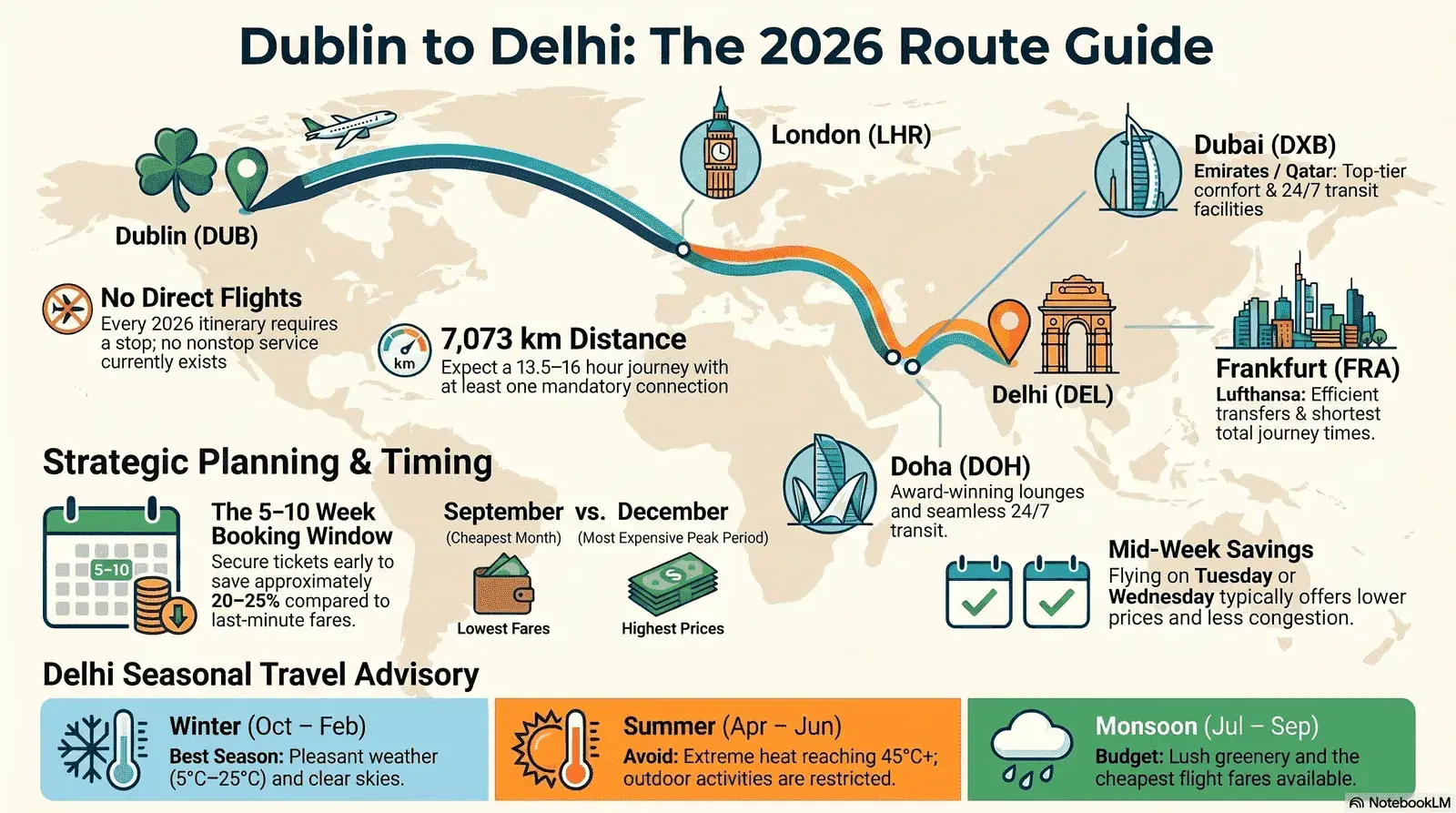
- No direct Dublin–Delhi flight exists. All itineraries require one connection, typically through Dubai, Abu Dhabi, or Doha — expect 12–16 hours total travel time via Middle Eastern hubs.
- Book 3–6 months ahead for the best economy fares. October to March is ideal for Delhi weather and festival experiences; summer and the Diwali/December peak push fares 30–50% higher.
- Irish citizens need an Indian e-Visa plus a mandatory e-Arrival Card. Both must be completed online before you board — the e-Arrival Card is a newer requirement many travellers miss.
Few journeys in the world offer such a dramatic shift in landscape, culture, and sensory experience as the flight from Dublin to Delhi. You board on the windswept Irish coast and land in one of the world's most storied capitals - a city of Mughal monuments, chaotic bazaars, and extraordinary food. Whether you are an Irish traveller visiting India for the first time, an Indian professional based in Ireland heading home, or a seasoned globetrotter exploring new routes, this guide covers everything you need to know about the DUB to DEL route in 2026.
- Distance: approximately 7,073 km
- Typical total journey time: about 13.5–16 hours with 1 stop, depending on layover
- Recent return economy fares: often from about €480–€650 in off-peak periods
- Direct nonstop flights: none – at least 1 stop is required on all current itineraries
Is There a Direct Dublin to Delhi Flight?
The short answer: no direct nonstop flight operates between Dublin Airport (DUB) and Indira Gandhi International Airport (DEL) as of 2026. Every itinerary on this route requires at least one connection, with total travel times ranging from approximately 13.5 to 16 hours depending on your layover city and duration.
That said, the range of connecting options is excellent, spanning some of the world's finest hub airports - London Heathrow, Dubai, Abu Dhabi, Doha, Amsterdam, Frankfurt, and Paris Charles de Gaulle. You have no shortage of premium and budget-friendly carriers to choose from.
Top Airlines and Layover Hubs on the Dublin–Delhi Route
-
British Airways – via London Heathrow (LHR)
High weekly frequency and excellent connectivity to DEL via OneWorld partners. Typical layovers: around 2–4 hours at Heathrow, usually in Terminals 3 or 5, with strong lounge and dining options. -
Lufthansa – via Frankfurt (FRA)
Efficient hub with strong on-time performance. Frankfurt often offers some of the shortest total journey times on Europe–India routings. -
Emirates – via Dubai (DXB)
Economy, business and first class all available, with generous baggage on many fare types. DXB is a 24/7 hub with showers, sleep pods and extensive shopping and dining – ideal for overnight layovers. -
Etihad Airways – via Abu Dhabi (AUH)
Competitive fares and a modern hub. Flexible baggage policy based on total weight rather than pieces on many non-US routes, helpful for long stays. -
KLM Royal Dutch Airlines – via Amsterdam (AMS)
Compact hub with easy transfers, especially on tight connections. Good option for Flying Blue / SkyTeam loyalty collectors. -
Qatar Airways – via Doha (DOH)
Consistently strong service and highly rated business class. DOH offers fast minimum connection times and good overnight transit facilities. -
Air France – via Paris CDG
Often 20–30% lower fares than some other European hubs on this route, especially in sales periods. Youth fares are sometimes available for travellers under 26, making CDG particularly attractive for students. -
Air India – via multiple hubs
Frequently among the cheaper full-service options on the route when on sale. Attractive for passengers who want a single-airline experience once in the India leg of the journey.
Gulf carriers – Emirates, Etihad, and Qatar Airways – offer some of the most comfortable layover airports in the world and are a natural fit for this route. If your budget allows, their business class cabins on long-haul sectors are widely regarded as industry-leading, and student/youth discounts of up to 10% are sometimes available with valid ID on select dates.
How to Find the Cheapest Dublin to Delhi Flights
September is consistently one of the cheapest months to fly this route, with demand falling after the summer rush and before the Diwali and Christmas peaks. December is usually the most expensive period due to holiday travel and higher demand from both leisure and visiting-friends-and-relatives traffic.
Across multiple fare data sources, booking around 5–10 weeks before departure typically saves about 20–25% compared with last-minute purchases on this route. Travelling on a Tuesday or Wednesday rather than a Friday–Sunday often lowers prices and reduces airport congestion.
One underrated strategy: round-trip vs. separate tickets. On this route, traditional round-trip tickets are usually cheaper overall than buying two unrelated one-way fares – often by €100–€200 – especially with full-service carriers. However, mixing airlines on outbound and return can still pay off when timed with specific sales or when you want a different hub experience in each direction.
To really optimise price, combine these approaches:
- Be flexible by a few days either side of your ideal dates.
- Use “whole month” or “cheapest month” views on comparison sites to see seasonal patterns.
- Aim to lock in your ticket roughly 6–10 weeks before departure unless a genuine flash sale appears earlier.
Smart use of fare alerts and comparison tools
Use a reputable comparison site’s “whole month” view to spot the cheapest departure days within your window. Set price alerts for your target dates and route (DUB–DEL return); most major tools will email or push-notify you whenever fares drop below your selected threshold.
On myflightoffers.com, enable price alerts for your preferred airlines – for example, only Gulf carriers, or only SkyTeam – and receive notifications when those specific carriers run sales on Dublin–Delhi. When a fare appears at or below your target price (typically in the €480–€650 range for off-peak economy returns), book promptly, as the best prices on this route rarely linger for more than a few days.
Note on cabin class
Business class is available with most major carriers on this route. First class is available with Emirates on selected sectors via Dubai. If you are travelling for a special occasion or an extended work trip, the price premium on Gulf carriers’ business products often represents excellent value compared to European alternatives, once you factor in flat beds, lounge access, and higher baggage allowances.
Premium economy is slowly appearing on some Europe–India itineraries, sitting nicely between economy and business for comfort-focused travellers who do not need a full flat bed.
Baggage Allowances and Hidden Costs
For a Dublin–Delhi trip, baggage can easily add hundreds of euro if you misjudge it.
- Emirates: On many economy fares to India, typical allowances range from one piece up to 23 kg for “Special” fares to two pieces of 23 kg for more flexible fare types, with additional weight in premium cabins.
- Etihad: Uses a weight-based system on many non-US routes; you can check multiple pieces as long as you stay within your total allowance, with no single bag over 32 kg.
- British Airways, Lufthansa, Air France, KLM, Qatar: Commonly include at least one checked bag (often 23 kg) plus cabin baggage in standard economy, but basic/light fares sometimes remove checked bags entirely.
- Always confirm the baggage rules on your specific ticket before paying – basic/light fares are increasingly common on European segments.
- Buying extra baggage online in advance is usually much cheaper than paying at the airport, with differences of €50–€150 on some carriers.
- If you are relocating or packing heavy gifts, compare the cost of an upgraded fare class (with more baggage included) against paying for multiple extra bags.
Visa Requirements – What Irish and Indian Travellers Need to Know
For Irish passport holders travelling to India
- Visa required: yes
- Option: Indian e-Visa (tourist) is available online for most Irish travellers and is typically valid for multiple entries and stays up to 90 days per visit within a 1-year validity period
- Passport validity: at least 6 months beyond your intended date of arrival and at least 2 blank pages
- An online e-Arrival Card must usually be completed up to 72 hours before landing in India for immigration clearance
- Always check the latest e-Visa rules and fees on the official government or authorised visa partner site before applying, as requirements and charges can change
For Indian passport holders travelling to Ireland
- Visa required: yes
- Most short-stay applications are processed via VFS Global in India, with biometrics required in person
- Typical processing time: 20–25 working days in normal periods, but it is safer to allow 6–10 weeks during peak seasons or if additional documents are requested
- You will usually need proof of funds (often around €50–€100 per day of stay), confirmed or provisional accommodation, and a return or onward ticket
- Travel and medical insurance with emergency coverage of at least €30,000 is strongly recommended and often required
- The British–Irish Visa Scheme (BIVS) allows some Indian nationals holding qualifying UK visas with BIVS endorsement to enter Ireland without a separate Irish visa; always confirm eligibility on official Irish government channels
Important: Ireland is not part of the Schengen Area. A Schengen visa does not grant entry to Ireland.
Best Time to Visit Delhi – Season by Season
Delhi is a city of extremes. Summers push past 45°C, winters can dip below 5°C, and the monsoon arrives with theatrical intensity. Choosing the right travel window makes an enormous difference to your experience on the ground.
Winter (October to February) – Best season
Temperatures range from 5°C to 25°C. This is the peak tourist season and the most comfortable window for exploring Delhi. Clear skies, pleasant daytime temperatures, and a busy festival calendar make this the ideal time for first-time visitors. Landmarks such as Red Fort, Qutub Minar, Humayun’s Tomb, India Gate, and Lodhi Gardens are best explored during this period.
Caution: Mid-November through January can bring heavy smog and poor air quality due to crop burning in neighbouring states. February and March offer cleaner air with similarly pleasant temperatures.
Autumn (October to November) – Great for festivals
Temperatures range from 20°C to 30°C. Post-monsoon freshness gives the city a vivid, photogenic quality. Diwali and Navratri bring spectacular colour, street celebrations, and cultural events. This is early peak season, so book accommodation and flights well in advance.
Summer (April to June) – Avoid if possible
Temperatures range from 35°C to 45°C+. Delhi’s summer is intense. Hot desert winds known locally as the “Loo” sweep in from the Thar Desert, making outdoor sightseeing uncomfortable and potentially dangerous for those unaccustomed to extreme heat. Flights and hotel rates are lower, but outdoor activities should be limited to early mornings.
Monsoon (July to September) – For the adventurous traveller
Temperatures range from 25°C to 35°C. The monsoon brings heavy but often sporadic rainfall, lush greenery, and a dramatic reduction in tourists. September is one of the cheapest months to fly from Dublin to Delhi. Street food culture thrives during this season, and the city’s historic architecture looks particularly striking in the rain.
Recommended for first-time visitors: October–November or February–March.
Tours & Sightseeing in Delhi
What to Pack for Delhi (Tips for Travellers from Ireland)
Coming from Ireland’s temperate, mild climate, the adjustment to Delhi’s extremes is significant regardless of season. Pack smart and you will thank yourself on day one.
October to March (winter / peak season)
- Light woollens or a mid-layer for daytime
- Warm jacket or fleece for evenings
- Comfortable, supportive walking shoes
- Scarf or shawl for religious sites
- Smog mask or N95 respirator for November–January visits
- Sunscreen SPF 50+
April to June (summer)
- Lightweight, loose cotton or linen clothing in light colours
- Wide-brimmed hat
- UV-400 sunglasses
- Refillable water bottle
- Electrolyte or rehydration sachets
- Sunscreen SPF 50+
July to September (monsoon)
- Light, breathable fabrics
- Compact travel umbrella
- Waterproof sandals or closed shoes with grip
- Anti-bacterial hand gel
- Dry bags or waterproof pouches for electronics and documents
Year-round essentials
- Universal plug adapter: Delhi uses Type C, D, and M sockets at 230V / 50Hz
- Modest clothing for temple and mosque visits
- Physical or printed copies of your visa, insurance, and hotel bookings
- Travel insurance covering medical emergencies, trip cancellation, and baggage
Dublin Airport & Delhi IGI – What to Know
Departing from Dublin
Dublin Airport (DUB) operates through Terminal 1 and Terminal 2, with international carriers spread across both. Always check your airline’s specific terminal before you travel. The airport is well-connected to Dublin city centre via multiple bus services, including Airlink-style express options that take around 25–45 minutes depending on traffic.
For longer journeys like Dublin–Delhi:
- Consider Fast Track security (typically around €6–€8 when pre-booked) to reduce queueing time during busy periods.
- If you are driving, pre-book long-term parking; online rates are usually significantly lower than drive-up pricing.
- Terminal 2 offers a good range of food and drink options, including cafés, sit-down restaurants and bars both before and after security, such as Gourmet Burger Kitchen, Diep, Burger King, The Slaney, Harvest Market, and several coffee bars.
Airside transit at Dublin Airport is only possible within Terminal 2 between 04:00 and 16:00; outside those hours, passengers must clear border control and re-enter landside. If you are connecting through Dublin on separate tickets, allow generous time.
Arriving in Delhi
Indira Gandhi International Airport (DEL) has three main terminals, with Terminal 3 handling almost all full-service international arrivals. It is one of the largest aviation terminals in the world, with multiple lounges, extensive retail, and several ground transport options.
Key onward travel options:
- Airport Express Metro Line: connects Terminal 3 to New Delhi Railway Station in under 20 minutes and is usually the fastest way into central Delhi.
- App-based cabs and prepaid taxis: Ola, Uber and official prepaid counters are available in clearly signposted areas outside arrivals.
- Domestic connections: If you are flying on to cities like Mumbai, Bengaluru, Hyderabad or Kolkata, check whether your domestic sector departs from the same terminal and whether your bags are checked through – being on a single ticket makes misconnects easier for airlines to handle.
Delhi Transport & Travel Services
Student and Youth Travellers – Extra Ways to Save
There is a significant student and young professional corridor between Ireland and India. Many airlines and partners offer additional savings:
- An International Student Identity Card (ISIC) can unlock up to about 10–20% off on selected airlines such as Emirates and Turkish on certain routes, plus occasional hotel and booking-site discounts.
- Some carriers, including Air India and others, periodically offer student concessionary fares that add extra baggage (often up to 10 kg more) alongside a small base-fare discount.
- For students, flexibility on dates and willingness to accept slightly longer layovers often produce the best Dublin–Delhi deals.
Mobile Booking and Apps
Many travellers now complete the entire booking process on their phones. Airline and OTA apps sometimes offer:
- App-exclusive promo codes or discounts, occasionally reducing return fares by €20–€50 compared with desktop prices.
- Real-time notifications if your watched route (DUB–DEL) drops in price or if your booked flight changes schedule.
- Better management of multi-city and open-jaw itineraries (for example, Dublin–Delhi outbound and Mumbai–Dublin return).
If you like to monitor prices over several weeks, installing both airline and aggregator apps can give you a useful second view alongside browser-based searches.
Food & Dining in Delhi
Final Word
The Dublin–Delhi route may lack a nonstop connection for now, but what it lacks in directness it more than compensates for in the quality and variety of its options. With multiple major airlines, world-class hub airports, and fares that reward those who plan ahead and stay flexible, the journey is as manageable as it is rewarding.
Plan early, watch prices over a few weeks, choose your hub and airline with care, and time your visit to Delhi’s more temperate seasons. When you are ready, use myflightoffers.com to compare live Dublin–Delhi fares across carriers, set free price alerts, and lock in a route that matches your budget, schedule and comfort priorities.
- Beat Jet Lag on Ireland-India Flights: The Science-Backed Long-Haul Survival Guide 2026 — pre-flight sleep-shifting tactics, Gulf hub layover strategies, melatonin prescription rules in Ireland, and seat tips on A380s and 777s.
- Dublin Airport Passenger Cap Lifted 2026: What It Means for Flights and Fares to India — Ireland's Dáil passed the cap-removal bill on 30 June 2026. Understand how this affects Gulf carrier frequencies on DUB–DEL, the realistic timeline for a direct flight, and booking strategy for winter 2026/27.
- Dublin to Kochi (COK) Flights 2026 — Route Guide, Best Airlines & Booking Tips — Same Gulf-hub routing logic applied to the Kochi route: Etihad via AUH dominates, fares, baggage, OCI e-Arrival Card rules and Indian bank card offers explained.
- Premium Economy vs Economy on Ireland-India Routes 2026: When Is the Upgrade Worth It? — seat specs, lounge access rules, and a True Cost Formula to decide if the extra spend makes sense on your next Dublin–India booking.
For broader fare timing patterns beyond this route, see our Best Day to Buy Airline Tickets guide.
If you also fly within Europe, read Exploring Europe: Cheap Flights from Dublin for destination and budget strategy ideas.
Considering a UK summer instead? See How to Plan a UK Summer Break on a Budget for complete accommodation, dining, and transport hacks.
- Middle East Layover Guide: Dubai, Doha & Abu Dhabi for India–Ireland Travelers (2026) — turn your DXB, DOH or AUH transit into a free hotel stay or city tour; visa rules for Indian passport holders at all three hubs
- Dublin to Bangalore (BLR) Flights 2026 — Route Guide, Best Airlines and Booking Tips — heading to Bengaluru instead? Full hub comparison (Etihad AUH vs Qatar DOH vs Emirates DXB), fare benchmarks, and true cost breakdown including baggage
- Dublin to Chennai (MAA) Flights 2026 — Route Guide, Best Airlines & Booking Tips — same Gulf-hub routing logic for the Chennai route: Etihad via Abu Dhabi cheapest from ~$358 in September, with baggage true-cost breakdown, e-Arrival Card rules, and DCC payment traps explained
- EU261 Flight Delay & Cancellation Compensation Guide 2026: Claim Up to €600 on Ireland-India Routes — your DUB-DEL departure on Emirates or Qatar is fully covered by EU261; learn how to claim €600 for free without giving 35% to a claims company
- Dublin to Amritsar (ATQ) Flights 2026 — Route Guide, Best Airlines and Booking Tips — flying onward from Delhi to Amritsar or planning a Punjab stopover? Compare Qatar Airways via Doha, Air India via DEL, and Emirates via Dubai; includes wedding-season fare peaks, kirpan rules, and ground transport to Jalandhar
Frequently Asked Questions
Is there a direct flight from Dublin to Delhi?
No, there is no direct (nonstop) flight between Dublin (DUB) and Delhi (DEL). All routes require at least one connection, typically through Middle Eastern hubs like Dubai (DXB), Abu Dhabi (AUH), or Doha (DOH), or European hubs such as London Heathrow (LHR) or Amsterdam (AMS).
Which airlines fly from Dublin to Delhi?
Emirates via Dubai, Etihad via Abu Dhabi, Qatar Airways via Doha, and Lufthansa via Frankfurt are the most popular options. Emirates and Etihad typically offer the shortest total journey times of around 11-12 hours including the connection.
How long does the flight from Dublin to Delhi take?
Total travel time is typically 11-15 hours depending on the connecting hub and layover duration. Emirates via Dubai averages around 11-12 hours gate-to-gate. Longer layovers in London or Frankfurt can push the journey to 18 hours or more.
When is the cheapest time to fly from Dublin to Delhi?
The cheapest months to fly Dublin-Delhi are typically September to early November and January to February, outside school holidays and Indian festival seasons. Booking 6-10 weeks in advance for these periods can yield fares from €380-€500 return.
Ready to book? Compare live Dublin to Delhi fares now
Find the cheapest flights, compare airline layovers (Emirates, Qatar, Etihad), and check live fare calendars before you buy.
- Airline Loyalty Programs for Ireland-India Flyers 2026: Avios vs Skywards vs Privilege Club vs Maharaja Club — how to earn the most miles on the Dublin–Delhi route and which programme gives the best award value for your profile
Prices, flight schedules, baggage rules and visa policies are subject to change. Always verify current requirements with your airline, visa provider and the relevant embassy or consulate before travel. All information in this guide reflects public data and typical fares available as of April–May 2026.